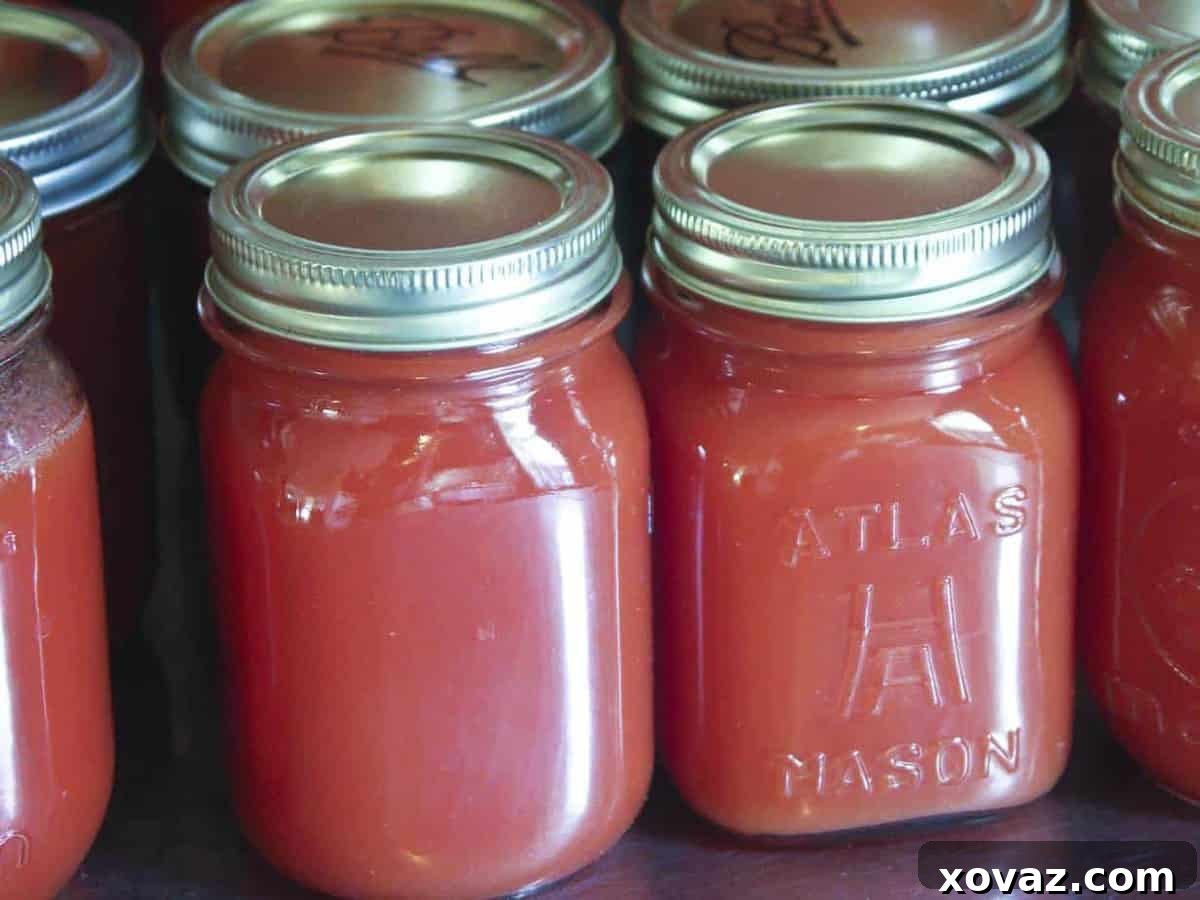
Homemade V-7 Garden Vegetable Juice: A Legacy of Flavor and Family Canning Traditions
A few weeks ago, my mother embarked on a cherished journey to Michigan, eager to reconnect with her sisters—my dear aunties—and, of course, my beloved Grandma. These visits are more than just trips; they are vital threads in the fabric of our family, weaving together generations with shared laughter, stories, and the comforting aroma of home-cooked goodness.
One memorable evening, as twilight settled over the Michigan landscape, Mom, my baby sister, the “Shaffer girls” (as they affectionately become when united), and Grandma gathered around the heart of any home: the kitchen table. The conversation flowed easily, circling around family news, garden plans, and, inevitably, food. It was then that Grandma, with a twinkle in her eye, introduced an unexpected element to their cozy evening: the game.
Boggle. For anyone who knows my grandmother, her gentle demeanor and boundless kindness are immediately apparent. She embodies sweetness; a woman whose life has been a testament to selfless care. My late grandfather, a pastor, often brought home strays—both people and animals—and Grandma, without hesitation, fed every single one. Her compassion knows no bounds; I have never once heard her utter a harsh word or engage in idle gossip. She neither drinks nor swears, dedicating her life to nurturing everyone who crosses her path. Yet, beneath this serene exterior lies a formidable spirit, particularly when a Boggle board is in play.
Place Boggle before her, and my grandmother undergoes a fascinating transformation. The sweet, delicate lady morphs into a word-finding titan. She has, with impressive regularity, bested engineers, teachers, doctors of theology, English majors, physicians, and housewives. To my knowledge, in her 83 years, her Boggle record remains triumphantly undefeated. Grandma is not merely a thesaurus; she is a relentless, word-creating machine.
And let not her endearing sweetness deceive you. Woe betide anyone who dares to misspell a word or, worse, invent one. She will swiftly and decisively “lower the boom,” though not without immediately offering a comforting bite to eat, sensing your sudden, post-defeat famished state. This competitive streak is a rare glimpse into her feisty side. Playing Boggle is, in fact, the only occasion I’ve ever heard my Grandma talk smack. On that particular Michigan evening, she challenged my mom and aunties with a gleeful, “Come on. I’ll wallop the dang out of you!” She meant it, and they knew it, adding a playful edge to their cherished family gatherings.
These powerful, loving women were my collective mentors in the art of canning. Even now, with minimal effort, I can vividly recall them all—five generations of wisdom and laughter—seated around my grandmother’s sturdy kitchen table or relaxing on her porch. Their hands, calloused from years of tending gardens and homes, would be deftly peeling peaches, snapping green beans, preparing and packing plump tomatoes, or brining cucumbers into crisp pickles. These sessions, often marathon undertakings, would conclude with a well-deserved, unwinding round of Boggle, cementing bonds and creating indelible memories that define our family’s enduring connection to nature and self-sufficiency.
The sensory details of those days are etched into my memory: the gentle rocking of the canner on the stovetop, filling the kitchen with steamy warmth. Amidst the diligent work, the women would share stories, their voices intertwined with laughter, as they processed the massive harvest from Grandma’s prolific gardens, ensuring a bountiful supply for the long winter months. Nothing was ever wasted. If fresh produce couldn’t be immediately consumed, it was meticulously frozen, canned, or generously shared with the diverse wildlife inhabiting the surrounding woodlands, affectionately known as ‘Grandpa’s Mountain.’ Indeed, all creatures, great and small, thrived under my grandmother’s care and generosity, demonstrating a holistic approach to life that valued every resource.
I am profoundly blessed that these remarkable women continue their canning endeavors and remain vibrant, active presences in my life. We regularly connect—often by phone, but increasingly via email, as my Grandma is a surprisingly adept “techno-Grandma”!—to share our canning tallies, comparing notes on yields and new recipes. These exchanges are more than just updates; they are a continuation of the shared experience, a virtual gathering around the modern-day kitchen table.
And truly, there’s an incomparable satisfaction in descending those basement stairs, then struggling back up, laden with glistening jars of summery tomatoes and other homemade treasures, ready to transform a dreary winter day’s dinner into a burst of sunshine. The deep flavors and vibrant colors held within those jars are a testament to hard work and love. But the joy isn’t just in the making or the consuming; it’s profoundly amplified by the act of sharing what you’ve created, extending the warmth and bounty of our family traditions to others.
My sister and I are proudly upholding this treasured family tradition. We diligently prepare essential staples like tomatoes, vibrant salsa, crunchy pickles, and sweet jams, ensuring our pantries are well-stocked. Yet, we also consult each other annually, always striving to craft something novel, ensuring we each have unique creations to swap. This friendly exchange not only diversifies our pantries but strengthens our bond, adding a layer of creative challenge to our shared heritage. Each year, we also endeavor to devise a plan to deliver our homegrown bounty to our cherished Michigan family, keeping the cycle of generosity and connection alive across the miles.
Just this past summer, recognizing that a trip up north to “the mitt” (Michigan’s Lower Peninsula) to visit Grandma and the aunties wouldn’t be possible, I seized a brief opportunity to see Aunt Sarah. With her, I entrusted a carefully packed, somewhat heavy box filled with jars of my pickles and jam, destined for distribution among Grandma, Aunt Molly, Aunt Vicki, and our many cousins during her visit. (Rest assured, I didn’t impose a massive burden on a frail elder. My Aunt Sarah, only a few years my senior, graciously accepted, not least because I included an extra jar of her favorite pickles as payment for her carrying services. Though, she might also have agreed simply because she loves me dearly. The next time we speak, I’ll be sure to inquire if it was for love or for pickles.)
My only regret from that time was not having access to fresh tomatoes before Aunt Sarah’s visit. Had I, I would have enthusiastically sent along jars of one of our more recent and beloved creations: V-7 Juice. This particular canning recipe holds a special place in my heart, deeply reminiscent of my grandma’s practical wisdom and her ability to make the most of every harvest, turning garden abundance into delicious, nutrient-rich provisions.
This seven-vegetable juice blend is an ingenious way to utilize the various odds and ends from a well-stocked garden, ensuring that nothing goes to waste and maximizing your harvest. But don’t fret if you lack a personal garden! This wholesome juice can be easily assembled with fresh, quality vegetables readily available at any local grocery store or bustling farmer’s market. It’s a versatile recipe designed for everyone, bringing the taste of the garden to your table no matter your circumstances.
And while it’s tempting to “rustle up” an eighth ingredient to transform it into a homemade V-8, for our family, it remains V-7. With my husband, our kids, and myself, we are a family of seven. Perhaps it’s a touch of symbolic sentimentality, or perhaps I simply revel in these quirky, nostalgic moments. Whatever the reason, V-7 it is, and V-7 it shall remain, a small nod to our unique family unit. (Yes, I realize that may sound a bit like Yoda. “Strange that may make me. Talking like Yoda am I. A V-7 I need.” *Promise to stop talking like Yoda do I. Hard to quit it is…*)
Be advised, crafting this juice is a delightful project, not particularly difficult, but certainly time-consuming. You’ll want to allocate approximately five hours from start to finish. The good news is that these five hours don’t have to be consecutive; you can easily divide the process over a couple of days to fit your schedule, making it manageable even for busy lifestyles. The reward? A surpassingly fresh flavor that is unequivocally worth every minute of effort. This homemade blend is infinitely superior in taste and nutritional value compared to any store-bought canned vegetable juice. It truly “smokes it.” Dare I say, it unequivocally “wallops the dang out of” store-bought vegetable juice blends? I do, and you will too once you taste the difference.
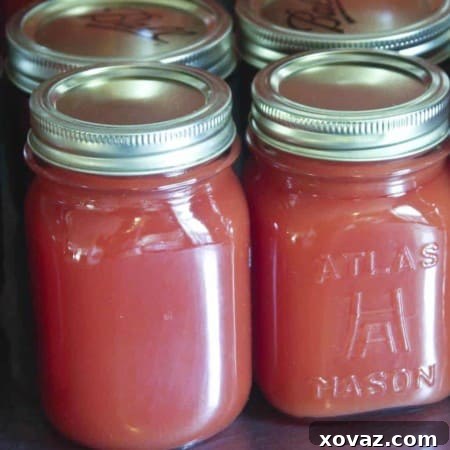
Homemade V-7 (not 8) Garden Vegetable Juice Blend
Rate Recipe
Rebecca Lindamood
Pin Recipe
Share on Facebook
Ingredients
- 24 pounds tomatoes
- 1 pound carrots scrubbed and diced
- 1 head celery scrubbed and diced
- 1 cup diced onions
- 1 large bunch parsley washed (This can be found bundled at the store if it is not in your garden. If you grow it, firmly pack a measuring cup with washed parsley still on its stems.)
- 1 Tablespoon Kosher or sea salt optional
- Bottled lemon juice use the best stuff you can afford here.
Instructions
-
Wash the tomatoes thoroughly and carefully slice a shallow wedge from the top, stem-end, to remove the core. For small to average-sized tomatoes, cut them into quarters. For larger tomatoes, cut them into eighths. Begin by adding a couple of cups of the chopped tomatoes at a time to a large, non-reactive stockpot (glass, enamel, and stainless steel are ideal choices) set over medium-low heat. Gently break them up with a large spoon or potato masher. Continue this process, adding tomatoes and breaking them down after each addition, until all the tomatoes are in the pot. Then, add the prepared carrots, celery, onion, and parsley to the pot, stirring well to combine all ingredients. Increase the heat to medium-high and bring the mixture to a boil, stirring frequently to prevent any scorching or sticking to the bottom of the pot. Once boiling, reduce the heat to a simmer and cook for approximately 35 minutes, or until the carrots and celery are mostly tender.
-
Carefully position a sturdy strainer over a large bowl or a second large, non-reactive stockpot. Ladle the cooked vegetables and their flavorful juice into the strainer. Once all the liquid has drained and been collected, return the strained liquid to the (now rinsed) original stockpot. Next, juice the remaining solid vegetables (or process them until smooth in a food processor or food mill). Strain this pulpy mixture once more over the stockpot to ensure all seeds and peels are removed, yielding a smooth juice. If you are opting to use salt, stir it into the collected juice at this stage.
-
Heat the vegetable juice until it reaches 190°F. It is crucial NOT TO ALLOW IT TO BOIL! If you do not have a thermometer, 190°F is typically indicated by a significant amount of steam rising from the surface of the juice, but with no active bubbles breaking the surface. Maintain this temperature consistently for 5 minutes.
-
Add 1 Tablespoon of bottled lemon juice to each sterile* pint jar and 2 Tablespoons of bottled lemon juice to each sterile* quart jar you intend to fill. Carefully ladle the hot juice into the prepared jars, ensuring you leave 1/4 inch of headspace at the top. Wipe the rims of the jars meticulously clean, then affix the lids, and tighten the rings just until resistance is met – avoid over-tightening.
-
*If you require assistance in understanding what “sterile” means or how to properly sterilize your canning jars, please click here for a helpful guide!
-
Fill your canning pot approximately halfway with tepid (lukewarm) water. Carefully arrange the filled jars around the base of the canner. Add more water, if necessary, until the jars are covered by at least 2 inches of water. Cover the canner and bring the water to a full, rolling boil. Begin timing the processing from the moment the water reaches this vigorous boil. Process quart jars for 40 minutes and pint jars for 35 minutes. Once processing is complete, carefully transfer the hot jars to a cooling rack or a towel spread on your countertop. Allow them to cool undisturbed overnight.
-
To check for a proper seal, gently press the center of each jar lid. If the jar has sealed correctly, the lid will be tight and will not flex or pop down. If the seal has failed, the lid will pop down when pressed and then spring back up. Any jars with failed seals should be immediately placed in the refrigerator and consumed within a few days. The remaining properly sealed jars can be stored in a cool, dark place, such as a cupboard or basement, for up to one year, allowing you to enjoy your homemade V-7 juice throughout the seasons.
Nutritional information provided is an estimate and offered as a courtesy. For precise nutritional values, it is recommended to calculate them using the actual ingredients in your recipe and your preferred nutrition calculator.
Did you make this recipe?
Make sure to tag @foodiewithfam on Instagram and #hashtag it #foodiewithfamily so I can check it out!
Pin Recipe
Share on Facebook