

Today, we’re embarking on a culinary journey to master one of the most versatile and flavor-packed ingredients: Ghee. Whether you’re a seasoned chef or a home cook looking to elevate your dishes, understanding and making your own ghee is a truly rewarding experience. For some, the mention of “ghee” brings a knowing nod of appreciation, while for others, it might spark curiosity about this golden elixir. The simplest way to describe it? Pure “Heaven in a Jar.”
What is Ghee? Unveiling the Golden Elixir
Ghee, pronounced “gee” with a hard ‘g’, is far more than just clarified butter. It’s a traditional, deeply aromatic fat that originates from ancient Indian culinary and medicinal traditions, celebrated for its unique flavor and extended shelf life. The process of making ghee involves slowly melting down unsalted butter and cooking it gently until all the water evaporates, and the milk solids separate and then caramelize, toasting beautifully at the bottom of the pan. This meticulous, low-and-slow cooking method leaves behind only pure, golden butterfat with an intensely nutty, deep, and toasted butter flavor that is simply irresistible.
Unlike regular clarified butter, which is typically cooked just until the milk solids separate, ghee is allowed to simmer longer. This extra cooking time is what transforms it, imparting that distinctive amber color and concentrated, complex taste. It’s this gentle caramelization of the milk solids that gives ghee its signature rich aroma and makes it a staple in many cuisines worldwide.
Why Should Homemade Ghee Be a Staple in Your Kitchen?
There’s a myriad of compelling reasons why ghee deserves a permanent spot in your pantry, refrigerator, or freezer. From its remarkable flavor to its impressive health benefits and cooking versatility, ghee is a true kitchen powerhouse.
1. An Unparalleled Flavor Profile
First and foremost, the TASTE! Ghee isn’t just confined to Indian dishes; its rich, nutty, and slightly sweet flavor adds incredible depth to almost any cuisine. Imagine the best browned butter you’ve ever tasted, but with even greater stability and versatility.
- Everyday Cooking: It’s the ultimate fat for frying or scrambling eggs, searing a succulent steak or other cuts of meat, or sautéing vibrant vegetables and delicate seafood.
- Baking & Spreading: Spread it over freshly baked bread to keep the crust soft and add a layer of rich flavor, stir it into oatmeal for a comforting depth, or even drizzle it over popcorn for a gourmet touch.
- Enhancing Any Dish: Ghee brings a warm, nutty richness to soups, stews, rice dishes, and even coffee. It’s like having a ready source of browned butter at your fingertips, ready to elevate nearly any meal you create.
2. Superior Stability for High-Heat Cooking
The clarifying process dramatically raises the smoke point of butter. While regular butter begins to smoke and burn at a paltry 250°F (121°C), ghee boasts an impressive smoke point of 485°F (252°C). This makes it an ideal fat for high-heat cooking methods such as searing, frying, roasting, and deep-frying.
- Preventing Scorching: You can sear a steak to perfection or achieve a beautifully crisp sauté without the risk of scorching, a common issue with regular butter.
- Healthier Cooking: Cooking oils past their smoke point can lead to the formation of harmful free radicals. Ghee’s high smoke point ensures a more stable and potentially healthier cooking environment, preserving the integrity of your ingredients and the fat itself.
- Versatility: Its stability even surpasses that of popular cooking oils like peanut oil, canola oil, and many vegetable oils, making it a robust and reliable choice for a wide array of culinary applications.
3. Remarkable Shelf Life and Economic Advantage
Making ghee extends the life of butter significantly, offering both convenience and an economic benefit. When you find large quantities of butter on sale, transforming it into ghee is not just a flavor booster but a smart way to preserve your investment.
- Butter Shelf Life: Regular butter is typically considered good for about 1 month after the sell-by date when refrigerated, or 6 to 9 months in the freezer.
- Ghee Shelf Life:
- Unopened: Ghee can be stored, unopened, in a cool, dark place (not necessarily refrigerated) for up to 9 months.
- Opened on Countertop: Once opened, a jar of ghee can be kept on your countertop for up to 3 months.
- Refrigerated: Beyond that, an open jar stored in the refrigerator can last for up to 1 year.
- Frozen: A jar of ghee stored in the freezer at 0°F (-18°C) can be kept indefinitely, making it an excellent long-term storage solution.
4. A Crucial Component in Diverse Global Cuisines
Ghee is a foundational ingredient that shapes the flavor profile of countless international dishes. Its importance spans across various culinary traditions, from the vibrant spices of India to the rich stews of the Middle East and beyond.
- Indian Subcontinent: Ghee is indispensable in Indian, Pakistani, and Bangladeshi cooking, used in everything from curries and dals to rice pilafs, desserts, and tempering spices.
- Middle Eastern & Central Asian: It is a key flavor component in Syrian, Lebanese, Persian, Arabic, and Georgian cuisines, lending its distinctive richness to savory and sweet preparations.
- European Variations: Even German and French cuisines utilize similar clarified butter forms, such as Butterschmaltz and Beurre Noisette (brown butter), demonstrating the universal appeal of butterfat cooked to perfection.
5. Dietary Advantages for Sensitive Stomachs and Specific Lifestyles
For many, ghee offers a more digestible alternative to regular butter due to the removal of certain dairy components.
- Lactose and Casein Intolerance: The process of making ghee effectively removes the lactose and casein (milk sugars and proteins) from the butterfat. This makes it more digestible for individuals who experience unpleasant side effects from consuming butter or other dairy products due to intolerance. Important Note: This does NOT mean that someone with a true dairy ALLERGY can consume it. Always consult with a healthcare professional regarding severe allergies.
- Adherence to Specific Diets: Ghee is highly recommended and perfectly acceptable for those adhering to paleo, GAPS, Whole30, keto, and real food lifestyles as a nutritious and beneficial dietary fat. It provides healthy fats without the inflammatory components sometimes associated with conventional dairy.
- Nutrient Density: Especially when made from grass-fed butter, ghee is rich in fat-soluble vitamins like A, E, and K2, and contains conjugated linoleic acid (CLA), which are associated with various health benefits. It also contains butyric acid, a short-chain fatty acid that supports gut health.
How to Make Ghee at Home: Your Guide to Liquid Gold
Making ghee at home is surprisingly simple, requiring more patience than skill. The basic principle is to melt unsalted butter slowly and cook it long enough to separate and toast the milk solids, leaving behind pure butterfat.
Choosing the Right Ingredients and Equipment
- Unsalted Butter is Key: Always start with fresh, high-quality unsalted butter. There are two primary reasons for this:
- Freshness: Unsalted butter generally tends to be fresher than salted varieties, ensuring a better starting product.
- Salt Concentration: As ghee is made, the water evaporates, concentrating any salt present. Using salted butter can result in an unpalatably salty final product.
- Heavy-Bottomed Pot: Use a large, heavy-bottomed stockpot or soup pan. The heavy base helps distribute heat evenly, preventing the milk solids from scorching as they settle at the bottom of the pan.
The Slow Transformation Process
In essence, you’ll place a generous quantity of unsalted butter into your heavy-bottomed pot and set it over the lowest possible heat on your stovetop. Then, you simply let time and gentle heat do their work for several hours.
- Low and Slow: The goal is a gentle percolation, not a rolling boil. If your butter is “smiling at you” with tiny, consistent bubbles, you’re doing it right. This low heat is crucial to prevent burning and develop the desired nutty flavor.
- Occasional Stirring: While you don’t need to stir constantly, give it a good stir every so often, gently scraping the bottom of the pan. This helps to prevent the milk solids from completely adhering and scorching, which can impart an undesirable flavor to your ghee. They will settle at the bottom, but preventing them from cementing there ensures a better tasting ghee overall.
- Patience Rewarded: This process typically takes 4-6 hours, depending on the quantity of butter and the heat setting. You don’t need to be tethered to the stove, but it’s advisable not to leave the house entirely while it’s cooking.
Recognizing When Your Ghee is Done
You’ll know your ghee is perfectly done when several key indicators are met:
- Clarity and Color: The butterfat will be clear, deep golden, and translucent.
- Aromatic Delight: It will emit a distinct, rich, nutty aroma.
- Toasted Solids: A beautiful layer of golden-brown, toasted milk solids will have settled at the bottom of the pan.
- Foam Layer: A layer of foam might still be floating on top – this is perfectly fine and will be removed during straining.
Straining and Purification
Once cooked, the next crucial step is straining your ghee to remove any lingering impurities, which is vital for its extended shelf life.
- Prepare Your Setup: Line a fine-mesh sieve with a clean flour sack towel, muslin cloth, or butter cheesecloth. If you don’t have a fine-mesh sieve, you can line a colander with a double thickness of these materials. Position this straining setup over a heat-safe pitcher or a large bowl.
- Careful Ladling: Gently ladle the hot ghee into the lined sieve or colander, allowing the pure butterfat to filter through into your receiving container. The toasted milk solids and any remaining foam will be caught in the cloth.
- Don’t Waste the Foam! If there was a significant foam layer, you can carefully skim it off before straining. This foam, often called “butter scum,” is incredibly flavorful on its own. Spread it on some toast, and you’ll understand why many consider it a little taste of heaven!
Yield Expectation
Expect the volume of your butter to be reduced by at least 25% overall. For example, if you start with 10 pounds (approximately 20 cups) of butter, you might yield around 15 cups or slightly less, depending on the initial moisture content of your butter. This reduction is normal and simply the result of cooking out the water content.
Storing Your Homemade Ghee for Optimal Freshness
Proper storage is key to enjoying your homemade ghee for months to come.
Room Temperature Storage (with precautions)
Many traditional sources recommend storing finished, jarred, and cooled ghee in a cool, dark room for long-term storage. If you choose this method, it is highly recommended that you sterilize your jars before decanting the ghee into them. You can find tutorials on basic canning and jar sterilization here.
However, exercise caution. Factors like consistent temperature and humidity are critical. If you live in a warm or particularly humid climate (e.g., the South), you will definitely want to opt for refrigerator or freezer storage to prevent spoilage. Be aware that most food preservation authorities generally recommend the freezer for the safest long-term storage of fats. Make an informed choice based on your specific environment. Personally, I prefer to store my ghee in the refrigerator or freezer for peace of mind.
Refrigeration and Freezing
Ghee will solidify in the refrigerator, becoming firm like butter, but will remain stable for up to a year. For indefinite storage, the freezer is your best friend. When ready to use, simply scoop out what you need or allow a portion to soften at room temperature.
Now that you’re equipped with all the knowledge, let’s make some ghee! Get ready for your kitchen to smell absolutely terrific.


Homemade Ghee: The Ultimate Recipe
Author: Rebecca Lindamood
Prep Time: 5 minutes
Cook Time: 4-6 hours
Total Time: 4 hours 5 minutes (or up to 6 hours 5 minutes)
Yields: Approximately 15 cups (from 10 lbs butter)
The long, slow cooking process results in a concentrated nutty, toasted butter flavor. Many thanks to Liz of The Lemon Bowl and her Aunt Paula for sharing her method for making ghee and the inspiration to think BIG!
Ingredients:
- 4 to 10 pounds of unsalted butter (quality grass-fed butter recommended for best flavor and nutrition)
- Sterilized jars with tight-fitting lids (preferably canning jars with new 2-piece lids)
- 1 large, heavy-bottomed stockpot
- Fine-mesh sieve or colander
- Clean muslin cloth or flour-sack towel
- Heat-proof pitcher or large bowl
Instructions:
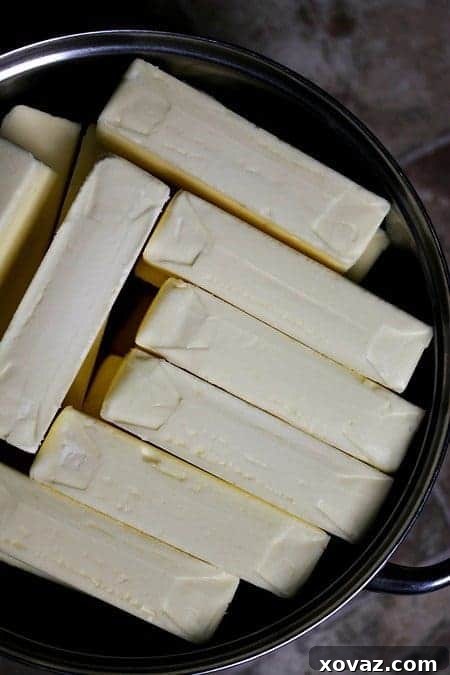
- Prepare the Butter: Unwrap all of the unsalted butter and add it to a large, heavy-bottomed stockpot.
- Start the Cooking Process: Place the stockpot over the lowest heat you can possibly manage on your cooktop. If you have a low-powered simmer burner, it is ideal for this job.
- Slowly Melt and Cook: Allow the butter to melt down and then cook gently for 4-6 hours, stirring every so often. The butter should maintain a steady, extremely low simmer – it should be percolating with small, quiet bubbles, not boiling vigorously.
- Observe the Transformation: During this slow cooking, the butter will go through several stages: it will melt, foam will appear on the surface, the milk solids will separate and sink to the bottom, and finally, the pure butterfat will become clear, deep golden, and translucent. The solids at the bottom will turn a toasted golden brown. Some foam may still float on top; this is normal.
- Prepare for Straining: Line a fine-mesh sieve with a clean piece of muslin cloth or a flour-sack towel. If you don’t have a fine-mesh sieve, you can line a colander with a double thickness of muslin or a flour-sack towel. Position this straining apparatus over a heat-proof pitcher or large bowl.
- Strain the Ghee: Carefully ladle the hot, clear butterfat into the lined sieve or colander, allowing the pure ghee to drip into the pitcher or bowl below. Discard the toasted milk solids left in the pot and the straining cloth.
- Jar and Store: When all the ghee has strained, carefully pour it into the sterilized jars, leaving about 1/2-inch of headspace from the top. Wipe the rims clean, secure the lids in place, and let the jars cool completely to room temperature before labeling and storing according to your preferred method (countertop, refrigerator, or freezer).
Nutrition (Estimated per serving, based on 120 servings):
- Calories: 203 kcal
- Fat: 22g
- Saturated Fat: 14g
- Cholesterol: 60mg
- Sodium: 202mg
- Potassium: 6mg
- Vitamin A: 710 IU
- Calcium: 7mg
Nutritional information is an estimate and provided to you as a courtesy. You should calculate the nutritional information with the actual ingredients used in your recipe using your preferred nutrition calculator.
Did you make this recipe?
We’d love to see your creations! Make sure to tag @foodiewithfam on Instagram and #hashtag it #foodiewithfamily so we can check it out!