
For years, the art of baking croissants at home has been shrouded in a mystique, often perceived as an intimidating challenge reserved only for professional patissiers. Many of you have expressed this apprehension, yet also a fervent desire to master this culinary delight. I’m thrilled to demystify the process and share a comprehensive guide on How to Make Croissants that will empower you to transform your kitchen into a French bakery. With this detailed tutorial, complete with step-by-step instructions and essential tips, you’ll soon be impressing yourself, your friends, and family with a basket overflowing with perfectly flaky, exquisitely buttery, and beautifully deep brown homemade croissants.
For those eager to explore more delightful bread creations, be sure to visit our dedicated Homemade Bread page, where you’ll discover an array of fantastic Bread Recipes.
The mere mention of croissants often conjures images of delicate, layered pastries, yet the thought of making them from scratch can feel daunting. It’s true that the process requires a certain commitment of time, often spanning a couple of days due to necessary chilling periods. This extended timeline can certainly sound off-putting and intimidating to the uninitiated baker.
However, let me assure you, the effort is profoundly rewarding. There’s truly nothing quite like pulling a tray of warm, golden-brown croissants, puffed and fragrant, straight from your own oven. The aroma alone is a testament to the magic happening in your kitchen, and the taste is an unparalleled experience that makes every minute of preparation worthwhile.

One common pitfall in many American bakeries is the pursuit of what I call “blonde croissants.” In a misguided attempt to avoid overbaking, these pastries often emerge pale, under-cooked, and severely lacking the characteristic depth of flavor and texture. A truly exceptional croissant boasts a rich, mahogany-colored exterior that shatters into a delightful shower of crumbs with every bite or tear. This crisp, caramelized crust provides a stunning contrast to the soft, airy, and meticulously layered interior.
Achieving this level of perfection is not as difficult as it seems when you have clear, concise guidance. That’s precisely what I’m here to provide. Follow along with our video tutorial and these detailed instructions, and you’ll soon be on your way to baking croissants that rival the best patisseries.
Imagine enhancing any special occasion with a beautiful basket filled with your own homemade pastries. The versatile dough used in this homemade croissant recipe is also the foundation for our classic and utterly irresistible Pain Au Chocolat {Chocolate-filled croissants or Chocolatines}. Master this foundational laminated dough, and a world of exquisite French pastries opens up to you. And I promise, while it demands patience, it’s not inherently difficult. Once you’ve conquered this dough, you’ll be ready to tackle even more exciting recipes coming soon to Foodie with Family!
Typically, my “Cook’s Notes” appear just before the recipe card, but given the detailed nature of this How to Make Croissants tutorial, these insights are crucial for navigating the process successfully. Therefore, I’ve placed them prominently at the beginning. Please keep these valuable tips in mind as you embark on your croissant-making journey.

Essential Cook’s Notes for Perfect Croissants
- Butter is King: In the realm of traditional French pastry, there is absolutely no substitute for high-quality unsalted butter. None. Zero. Zip. Avoid shortening, coconut oil, or tub margarines. While some claim vegan butter sticks can work, I haven’t tested this and therefore cannot recommend it for achieving authentic flavor and flakiness. The French cherish their butter, and for good reason—it’s the heart of a truly great croissant.
- Unsalted Butter is a Must: Given the substantial amount of butter in this recipe, it’s imperative to use unsalted butter. This allows you complete control over the salt content in your homemade croissants, ensuring the perfect balance of flavor. Trust me on this: unsalted butter is the way to go.
- Maintain Cold Temperatures: Throughout nearly every stage of this recipe, you’ll be working with cold butter and dough. The only exceptions are when the prepared pastries are proofing at room temperature and during the actual baking. If your butter or dough starts to become too soft or squishy during the rolling process, don’t hesitate to pop it back into the refrigerator for 20-30 minutes. You want the butter to be malleable enough to roll, but consistently cold and firm.
- The Advantage of a Silicone Mat: I highly recommend rolling your dough out on a silicone baking mat. These mats are often marked with measurements, making it incredibly easy to achieve precise dimensions for your dough. They also prevent the dough from sticking and tearing, allowing for smoother handling and transfer.
- Rest Your Dough When Needed: If you find your dough resisting or “fighting back” while you’re rolling it, do not force it. Tearing or over-stretching will compromise the delicate layers you’re working so hard to create. Instead, gently slide the dough onto a baking sheet and return it to the refrigerator for 20 to 30 minutes. This resting period allows the gluten to relax, making the dough much easier to roll out. Again, a silicone dough mat proves invaluable here for easy transfer.
- Plan Ahead for Easier Rolling: For the most cooperative dough, consider making it up to the point where you would roll it out, shape it, and bake it, then refrigerating it for at least 3, and up to 5 days, before the final shaping and baking. This extended cold rest allows the gluten to relax completely, making the dough incredibly easy to roll out—it will feel like a dream with no resistance whatsoever. If your schedule allows for this advanced planning, I wholeheartedly recommend it.
- Precision Cutting Tools: For cleanly cutting the dough without tearing the precious layers, I find a pizza cutter to be an excellent tool. It glides through the dough effortlessly and won’t damage your silicone mat. A bench knife is also a fantastic second option for precise cuts.
- Creating the Ideal Proofing Environment: If you’re struggling to find a warm, draft-free spot for your croissants to rise, your oven can be a perfect solution. Simply turn the oven light on (without any heat), and the gentle warmth it provides is usually sufficient. For a quicker rise, you can place a cake pan filled with boiling water on the shelf below your croissants to create a humid, warm environment.
Understanding the timeline is key to successful croissant baking. While the entire process can seem lengthy, it’s broken down into manageable steps, many of which involve passive chilling time. Here are two sample timelines to illustrate the flexibility you have:
Sample Timeline: Shortest Possible Croissant Preparation
- Day 1, 8:00 AM: Begin by preparing the croissant dough.
- Day 1, 9:15 AM: Place the dough in the refrigerator to chill. Simultaneously, shape and refrigerate the butter block.
- Day 1, 11:30 AM: Roll out the chilled dough, incorporate the butter through lamination, complete the first fold, and return to the refrigerator.
- Day 1, 1:30 PM: Take out half of the dough, roll it, shape your croissants, and allow them to rise at room temperature.
- Day 1, 2:00 PM: Preheat your oven and bake the croissants until golden brown.
- Day 1, 3:00 PM: Indulge in your freshly baked, homemade croissants!
Sample Timeline: Extended Croissant Preparation (Maximum Flexibility)
- Day 1, 8:00 AM (Tuesday, April 5th): Prepare the initial dough.
- Day 1, 9:15 AM (Tuesday, April 5th): Refrigerate the dough. Form and refrigerate the butter block.
- Day 2, 9:15 AM (Wednesday, April 6th): Remove dough and butter from the refrigerator. Roll out the dough, laminate the butter into it, perform the first fold, and return the dough to the refrigerator for an extended chill.
- Day 8, 9:15 AM (Wednesday, April 13th): Take out half of the well-rested dough, roll it out, meticulously form your croissants, and let them rise at room temperature.
- Day 8, 9:45 AM (Wednesday, April 13th): Preheat your oven and bake the exquisite pastries.
- Day 8, 10:00 AM (Wednesday, April 13th): Enjoy the fruits of your patient labor—perfectly baked croissants!
Are you ready to embark on this incredible baking adventure? Roll up your sleeves, gather your ingredients, and let’s get started. As long as you follow these instructions carefully, you are guaranteed to succeed. Here are the four main, detailed steps to creating magnificent homemade croissants:
How to Make Croissants Step 1: Prepare the Dough
The foundation of any great croissant is a perfectly prepared dough. This simple yeast dough is enriched with just a touch of butter, contributing to its tender texture and flavor. I find the easiest method is to first mix the softened butter with the yeast, warm milk, sugar, and about half of the all-purpose flour. This initial blending ensures that the butter is evenly dispersed throughout the dough, which is crucial for uniform lamination later on.
While a stand mixer with a dough hook makes quick work of this task, you can certainly opt for the traditional method and mix everything by hand if you prefer. Once a homogeneous mixture is achieved, gradually add the remaining flour. Continue to mix until a soft, slightly sticky dough forms and begins to pull away cleanly from the sides of the bowl. If using a stand mixer, knead with the dough hook for approximately 5-7 minutes. If kneading by hand, turn the dough out onto a lightly floured counter and knead for about 8-10 minutes until it becomes smooth, elastic, and resilient.
Lightly grease a clean bowl (or use the stand mixer’s bowl if it’s large enough) and transfer the dough to it. Cover the bowl loosely with a clean tea towel. Allow the dough to rise in a warm, draft-free place for about one hour, or until it has visibly puffed up. Keep in mind that in a cooler room, this first rise might take an additional hour.
After the first rise, gently turn the dough out onto your counter. Using the palms of your hands, carefully flatten it into a rough rectangle. Fold the dough into thirds, much like you would fold a letter. This initial fold helps to create a more uniform shape for the subsequent lamination. Lightly spritz the inside of a gallon-sized zipper-top bag with cooking spray, then carefully slide the folded dough into the bag. Seal the bag tightly and place it into the refrigerator. It needs to chill for a minimum of 2 hours, but can be left for up to 24 hours. This chilling period is vital for firming up the dough and developing flavor.
How to Make Croissants Step 2: Prepare the Butter Block (Beurrage)
While your dough is undergoing its crucial chilling period, you can prepare the butter block, also known as the “beurrage.” This step can be done immediately after you’ve placed the dough in the refrigerator.
Begin by taking two half-cup sticks of unsalted butter. Cut each stick in half lengthwise, which will give you four long, narrow rectangles of butter. Set these aside briefly.
Lay out a piece of waxed paper or plastic wrap that is at least 12 inches long. Generously sprinkle the surface of the paper with all-purpose flour. Arrange the four sticks of butter side-by-side, touching each other, in the center of the floured paper. Sprinkle the top of the butter with more flour, then cover it with another piece of waxed paper or plastic wrap.
Using a rolling pin, gently but firmly smack the butter. This process, called “pounding the butter,” helps to soften it evenly without melting, making it malleable and pliable. Once the butter is consistently soft but still cool, begin to roll it out. Aim to create a rectangle that is approximately 6-inches by 9-inches. The goal is a uniform thickness and shape that will be easy to incorporate into the dough.
Once rolled, carefully wrap the butter block tightly in the same waxed paper or plastic wrap you used. Return it to the refrigerator for at least one hour, or until you are ready to proceed with the lamination process. It needs to be firm but still flexible enough to bend without cracking when it meets the dough.
How to Make Croissants Step 3: Laminate the Dough (Tourage)
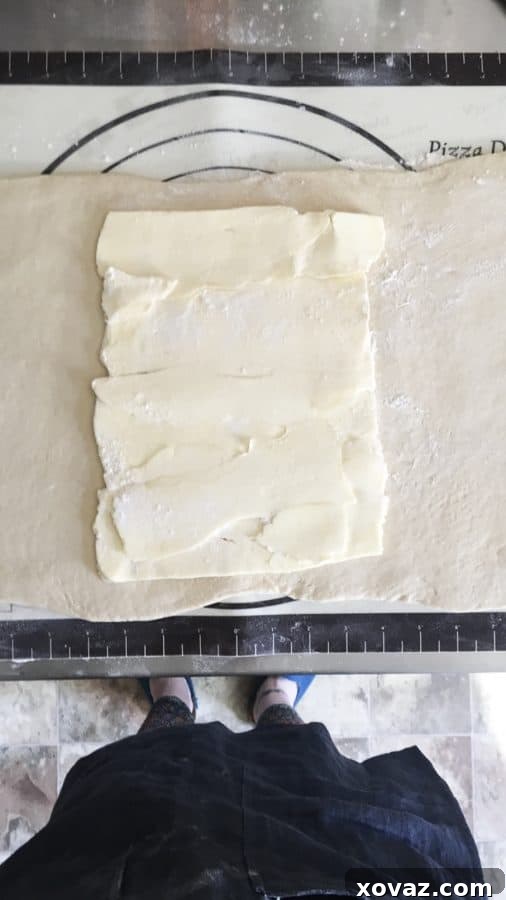
This is where the magic of creating those iconic flaky layers truly happens. Remove your chilled dough from its bag and place it onto a lightly floured counter or silicone mat. Carefully roll the dough out into a rectangle that measures approximately 10-inches by 20-inches. Try to keep the edges as straight and even as possible.
Next, retrieve your prepared butter block from the refrigerator. Unwrap it and carefully center it on top of your rolled-out dough. Position the butter so that it covers the middle third of the dough, leaving about one-third of the dough exposed on either side of the butter.
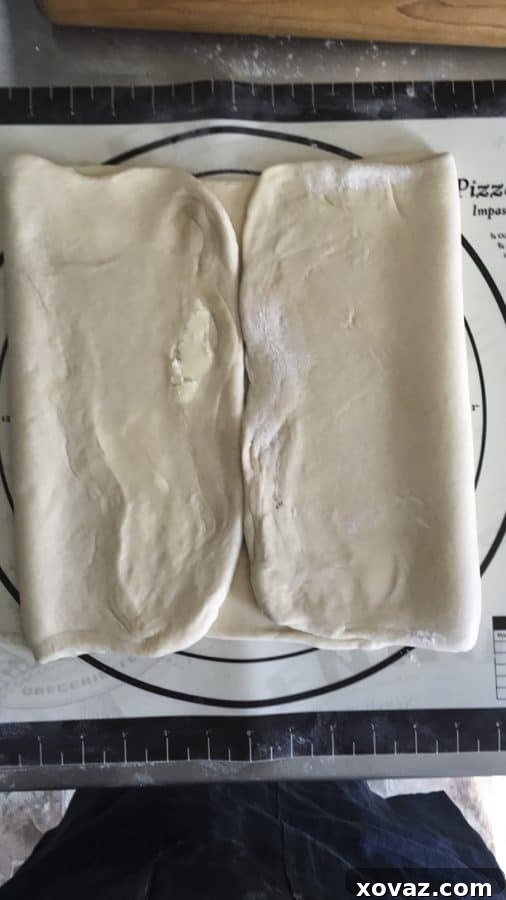
Now, meticulously fold one of the open sides of the dough over the butter block, ensuring it completely covers the butter. Then, take the other open side of the dough and fold it over the previously folded section, creating a neat, three-layered package—just like folding a business letter. Once folded, it is critically important to thoroughly pinch all the edges of the dough together. This step completely seals the butter within the dough, preventing any butter from escaping during subsequent rolling and baking, which would ruin the lamination.
Gently turn the dough package by 90 degrees. Lightly flour your work surface and the top of the dough. Carefully roll the dough out again, this time aiming for a rectangle approximately 10-inches by 24-inches. Focus on applying even pressure to maintain uniform thickness. For the next fold, you will perform a “book fold” or “double fold.” Fold both ends of the dough in towards the center, so their edges meet in the middle. Then, fold the entire package in half, as if closing a book. This creates four layers of dough and butter.
Carefully wrap this meticulously folded dough in floured plastic wrap and return it to the refrigerator. This critical chilling period should be at least 2 hours, allowing the butter to firm up and the gluten in the dough to relax. For maximum flexibility and ease of handling, this laminated dough can be refrigerated for up to 7 days before the final shaping and baking.
How to Make Croissants Step 4: Shape, Proof, and Bake
It’s time for the final, exciting steps that transform your carefully laminated dough into beautiful croissants! Remove the chilled dough from the refrigerator and unwrap it. For easier handling, cut the large dough block in half. Re-wrap one half and return it to the refrigerator, as you will work with the other half first.
On a lightly floured surface, take the working half of the dough and roll it out into a rectangle that is roughly 9-inches by 25-inches. Precision is important here for uniform croissants. Use a pizza cutter, a bench knife, or a sharp paring knife to trim the sides neatly, creating a precise 8-inch by 24-inch rectangle. This trimming ensures clean edges and consistent pastry shapes.
Now, using a zig-zag pattern, cut the rectangle into 8 to 10 long triangles. The base width of each triangle will determine the final size of your croissants. For a classic croissant shape, aim for a base of about 4-5 inches.
Working with one triangle at a time, gently grasp both corners of the base (the widest part of the triangle). Gently pull and stretch the dough slightly to elongate it, then begin to roll firmly but not tightly from the base towards the point. You want the dough to hold its shape as you roll, but without squishing the layers together. Continue rolling, gently tugging back on the already rolled portion to slightly stretch the unrolled slack. Keep rolling until you reach the tip of the triangle. Once you reach the tip, give it a final gentle stretch and wrap it underneath the croissant, pressing it lightly into place to secure it.
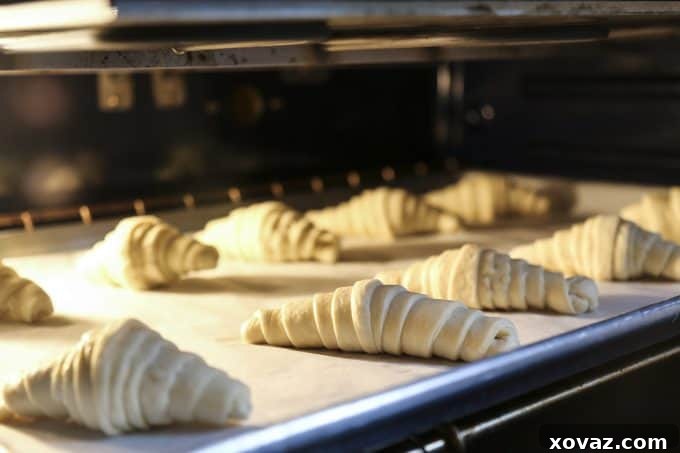
Position the rolled croissant on a parchment-lined baking pan with the tip resting securely on the pan. Repeat this process with all your remaining triangles, ensuring you place the rolled dough at least 3 inches apart on the pan. This generous spacing is crucial to account for the significant expansion that will occur during both the proofing and baking stages.
In a small bowl, whisk together one large egg with a pinch of salt until the color is even and consistent. This will be your egg wash. Lightly brush the tops of each croissant with this egg wash. Reserve the remaining egg wash by covering it and placing it back in the refrigerator.
Transfer the baking pan with the croissants to a warm, draft-free place to rise. This “proofing” stage is essential for the croissants to become light and airy. Allow them to rise until they are visibly puffy and slightly jiggly when gently nudged. This usually takes 1 to 2 hours, depending on the warmth of your environment.
Once the croissants have sufficiently proofed, preheat your oven to 425°F (220°C). Just before baking, retrieve the reserved egg wash from the refrigerator and brush the tops of the croissants once more. This double egg wash helps achieve that beautiful, deep golden-brown crust.
Bake the croissants for 15 to 18 minutes, or until the pastry is gloriously puffed, set, visibly flaky, and caramelized to a rich, deep rosewood brown. Do not be afraid of color—a well-baked croissant should have a substantial hue, indicating a perfectly crisp exterior and cooked-through layers. Once baked, let the pastries rest on the pan for about 5 minutes before carefully transferring them to a cooling rack. This brief rest allows them to set further and prevents them from deflating.
While these croissants are always at their absolute best when enjoyed slightly warm on the day they are made, any miraculous leftovers (a rare occurrence, I assure you) are still wonderfully delicious the following day. Simply rewarm them briefly in a toaster oven for a refreshed crispness.

Connect with Foodie with Family
Facebook | Pinterest | Instagram | Twitter
Make Croissant Baking Easier with These Recommended Tools
Having the right tools can make your croissant-making experience significantly smoother and more enjoyable. Consider adding these essential items to your kitchen arsenal:
- Silicone Baker’s Mat: Indispensable for rolling dough evenly and preventing sticking.
- Half Sheet Pans: Perfect for proofing and baking your croissants with ample space.
- Pizza Cutter: Excellent for clean, straight cuts through laminated dough without tearing.
- Stand Mixer: A powerful ally for effortlessly mixing and kneading dough.
- Bench Knife: Ideal for portioning dough, scraping surfaces, and making precise cuts.
- Parchment Paper: Ensures your delicate pastries don’t stick to the baking sheet and makes cleanup a breeze.
Recipe: Homemade Croissants
Experience the joy of baking authentic, flaky, and buttery croissants right in your own kitchen. This recipe yields a beautifully mahogany-colored pastry with a delicate, shattering crust that gives way to a soft, airy, and deeply layered interior. Pure perfection in every bite!
Recipe Details
- Author: Rebecca Lindamood
- Yields: Approximately 25 Croissants
- Prep Time: 45 minutes
- Cook Time: 20 minutes
Ingredients
For the Dough:
- 1 1/2 cups whole milk
- 1/4 cup granulated sugar
- 4 1/2 cups all-purpose flour (approx. 1 lb 3 1/8 oz by weight)
- 2 teaspoons instant or active dry yeast
- 2 teaspoons kosher salt
- 2 tablespoons unsalted butter, softened
For the Butter Block (Beurrage):
- 2 sticks unsalted butter (1 cup by volume, 8 ounces by weight)
- All-purpose flour, for dusting
Additional Ingredients:
- 1 large egg, whisked with 1 tablespoon of water (for egg wash)
- 1 pinch kosher salt (for egg wash)
Instructions
To Make the Dough:
- In the bowl of a stand mixer fitted with a batter blade (or using a large mixing bowl for hand mixing), combine the softened butter with the yeast, salt, milk, sugar, and about half of the all-purpose flour. Mix until a homogenous mixture forms.
- Add the remaining flour and continue to mix until a soft dough forms that begins to pull away from the edges of the bowl. If using a stand mixer, switch to the dough hook and knead for 5-7 minutes until smooth and elastic. If mixing by hand, turn the dough onto a lightly floured surface and knead for 8-10 minutes.
- Lightly grease the stand mixer’s bowl (or a separate clean bowl), form the dough into a tight round, and return it to the bowl. Cover with a clean tea towel. Let the dough rise in a warm, draft-free place for about 1 hour, or until visibly puffy. In a cool room, this may take up to an additional hour.
- Lightly spray the inside of a gallon-sized zipper-top bag with cooking spray. Gently turn the dough out onto the counter, flatten it slightly with the palms of your hands, and fold it into thirds like a letter. Slide the folded dough into the prepared bag, seal it shut, and place it in the refrigerator for at least 2 hours, or up to 24 hours.
Prepare the Butter Block:
- While the dough is chilling, prepare your butter block. This can be done immediately after placing the dough in the refrigerator.
- Cut the two half-cup sticks of unsalted butter in half lengthwise, yielding four long rectangles.
- Lay a piece of waxed paper or plastic wrap (at least 12 inches long) on your counter and sprinkle it thoroughly with all-purpose flour. Arrange the four butter rectangles side by side, touching, on the floured paper. Sprinkle more flour over the butter and cover with another piece of waxed paper or plastic wrap.
- Gently smack the butter with a rolling pin until it becomes malleable. Then, roll it out until it forms an approximate 6-inch by 9-inch rectangle.
- Wrap the butter block tightly in the waxed paper or plastic wrap and return it to the refrigerator for at least 1 hour, or until it’s firm but still pliable.
Creating the Pastry (Lamination):
- Remove the chilled dough from its bag and place it on a lightly floured counter. Roll the dough out into a rectangle approximately 10-inches by 20-inches.
- Unwrap the refrigerated butter block and center it on the middle third of the dough. This leaves about one-third of the dough exposed on either side.
- Fold one open side of the dough over the butter, then fold the other open side of the dough over the first folded section, creating a three-layered package (like a letter fold). Thoroughly pinch the edges of the dough together to completely seal the butter inside.
- Turn the dough package 90 degrees. Lightly flour your work surface and the dough, then roll it out into a 10-inch by 24-inch rectangle.
- For the next fold (book fold), fold both ends of the dough inward so their edges meet in the middle. Then, fold the entire package in half, like closing a book.
- Wrap the dough tightly in floured plastic wrap and return it to the refrigerator for at least 2 hours, or up to 7 days, to chill and relax.
Putting It All Together and Baking:
- Remove the laminated dough from the refrigerator and unwrap it. Cut the dough in half. Re-wrap one half and return it to the refrigerator (for a second batch later, or for Pain au Chocolat).
- On a lightly floured surface, roll out the remaining half of the dough into a rectangle roughly 9-inches by 25-inches. Use a pizza cutter, bench knife, or sharp paring knife to trim the sides neatly, creating a precise 8-inch by 24-inch rectangle.
- Working in a zig-zag pattern, cut the trimmed rectangle into 8 to 10 long triangles, depending on your desired croissant size.
- Working with one triangle at a time: Gently grasp both corners of the base of the triangle. Lightly pull to stretch the dough slightly, then begin to roll firmly (but not tightly) from the base towards the point. Ensure it holds its shape without being squished. Continue rolling, gently tugging back on the already rolled portion to slightly stretch the unrolled dough. Roll until you reach the tip of the triangle. Stretch the tip to wrap it around and gently press it into place underneath the croissant.
- Position the rolled croissant on a parchment-lined baking pan with the tip resting on the pan. Arrange remaining triangles at least 3 inches apart to allow for expansion.
- In a small bowl, whisk together the large egg with a pinch of kosher salt until even in color. This is your egg wash. Lightly brush the tops of the croissants with the egg wash. Place the pan in a warm, draft-free place to rise until the dough is puffy and slightly jiggly (1-2 hours). Cover and refrigerate any remaining egg wash.
- Preheat your oven to 425°F (220°C). Brush the tops of the proofed croissants with the reserved egg wash one more time.
- Bake for 15 to 18 minutes, or until the pastry is puffed, set, beautifully flaky, and caramelized to a deep, rich rosewood brown.
- Allow the pastries to rest on the pan for 5 minutes before carefully transferring them to a cooling rack.
- Croissants are best enjoyed slightly warm on the day they are made. If by some rare chance there are leftovers, they are still delightful the next day, perhaps reheated briefly.
Nutrition Information (Estimated Per Serving)
- Calories: 177 kcal
- Carbohydrates: 20g
- Protein: 3g
- Fat: 9g
- Saturated Fat: 5g
- Cholesterol: 29mg
- Sodium: 196mg
- Potassium: 57mg
- Sugar: 2g
- Vitamin A: 285 IU
- Calcium: 23mg
- Iron: 1.1mg
Nutritional information provided is an estimate and offered as a courtesy. You should calculate the nutritional information with the actual ingredients used in your recipe using your preferred nutrition calculator.
Did you make this recipe?
Be sure to tag @foodiewithfam on Instagram and use the hashtag #foodiewithfamily so I can see your delicious creations!