The Unbeatable Versatility of Beans: A Culinary Staple and a Journey into Home Preservation
In the vast landscape of culinary ingredients, few rival the humble bean in its sheer versatility, nutritional power, and economic appeal. If I were to live a thousand years, I doubt I would exhaust the endless possibilities offered by these remarkable legumes. What’s not to love? They are, at once, incredibly inexpensive, packed with vital nutrients, remarkably easy to store, undeniably delicious, and capable of transforming into a myriad of dishes.
For those who have followed my culinary adventures here at Foodie With Family, my profound adoration for beans is no secret. They represent a cornerstone of smart family cooking – a quick, incredibly filling, and budget-friendly solution for nourishing a growing household. Their ability to adapt to nearly any cuisine, from hearty stews to vibrant salads, makes them an indispensable item in my pantry.
From Dried to Delicious: Unlocking the Magic of Pressure Canning
The notion of preparing beans from their dried state often draws skeptical looks. “Quick? Beans? Surely you aren’t making them from dried,” a doubting voice might exclaim. Ah, but yes, I most certainly am! And this is precisely where our discussion pivots from simply celebrating beans to wholeheartedly evangelizing about a transformative culinary technique: pressure canning. Specifically, modern pressure canning.
This shift requires a brief, yet essential, diversion, as understanding the tool is key to appreciating the magic it enables. Many associate dried beans with lengthy soaking times and hours of simmering on the stovetop. While traditional methods certainly have their charm, modern life often demands efficiency without sacrificing quality or nutrition. Pressure canning offers a brilliant solution, dramatically cutting down active cooking time while simultaneously preserving food for future convenience.
Dispelling Myths: The Modern Pressure Canner Revolution
Even if you, like me, grew up in a household where canning was a common practice, you likely heard chilling tales about pressure canners. Stories of “Aunt Bertha’s exploding canner” or close calls with “shrapnel” were cautionary tales passed down through generations. These vivid anecdotes, often an amalgam of real historical incidents and embellished family lore, painted pressure canners as inherently dangerous devices. The truth is, older models *were* dangerous. The operative word here, however, is ‘were.’
A new generation of pressure canners has emerged, fundamentally redesigning the safety landscape. The heirloom horror stories from ages past are rooted in a time when seals were often made of inferior rubber gaskets prone to warping, cracking, or deteriorating, leading to dangerous pressure failures. Today’s canners feature advanced engineering, boasting ratcheting, locking lids with robust metal-to-metal seals. These innovations provide a secure, airtight closure that significantly mitigates the risks associated with older models. Modern safety valves, pressure gauges (both dial and weighted), and interlocking mechanisms ensure that pressure is safely maintained and released, making contemporary pressure canning an incredibly safe and reliable method of food preservation when instructions are followed.
My own pressure canner, affectionately named Carol, has been thoroughly inspected and approved by “The Evil Genius” – my husband, who works daily with industrial sterilizers. His professional assessment: she’s the domestic equivalent of a small-scale industrial sterilizer. When a man who routinely observes vials explode in professional settings gives his seal of approval, you can trust it’s safe. (And on a brief tangent, isn’t it amusing that a man clearly NOT sterile – we have five sons in nine years – specializes in sterilizers? Just a thought.) The bottom line is this: pressure canning, when performed with a new model canner and adherence to manufacturer’s safety instructions, is remarkably safe and efficient. Just keep Aunt Bertha away from it, for old times’ sake.
Selecting Your Ideal Pressure Canner: An Investment in Home Food Security
When considering which pressure canner to invest in, there are several factors to weigh. I personally favor a larger model, such as my Carol, which is the second-largest made by the Wisconsin Aluminum Foundry. While it might be a bit more expensive than smaller counterparts or cheaper knock-offs, its capacity to hold and process fourteen quarts simultaneously is a game-changer. This means it’s twice as efficient as models holding only seven quarts, dramatically reducing the time spent on canning large batches. Furthermore, it easily doubles as a spacious boiling water canner, making it a truly versatile kitchen workhorse. Very few single appliances can offer the dual functionality and capacity of a high-quality pressure canner.
My loyalty to this company stems not just from the quality of their product, but from their exceptional customer service. When I mistakenly broke my gauge – entirely my fault, due to not reading the directions – they replaced it free of charge, even after I confessed my error. They even sent it via Priority Mail! That level of support solidifies my trust and appreciation for them. Investing in a reputable brand with excellent customer service is always a wise decision for a long-term kitchen appliance. While we started this conversation about beans, the benefits of a reliable pressure canner extend far beyond them.
The Ultimate Convenience: Introducing Canned Barbecue Beans
Speaking of beans, let’s get back to the specific culinary marvel that brought us here. My discovery of the fabulous and aptly named ‘Canning’ group on Facebook (a notorious time-hoover for me) led me to a picture of barbecue beans that one member had made. The original recipe described them as a clone of El Pollo Loco’s BBQ Black Beans. Having never visited an El Pollo Loco, I had no prior reference, but one glance at the simple method and the ingredients convinced me I had to try it. The promise of restaurant-quality flavor with minimal effort was too enticing to resist.
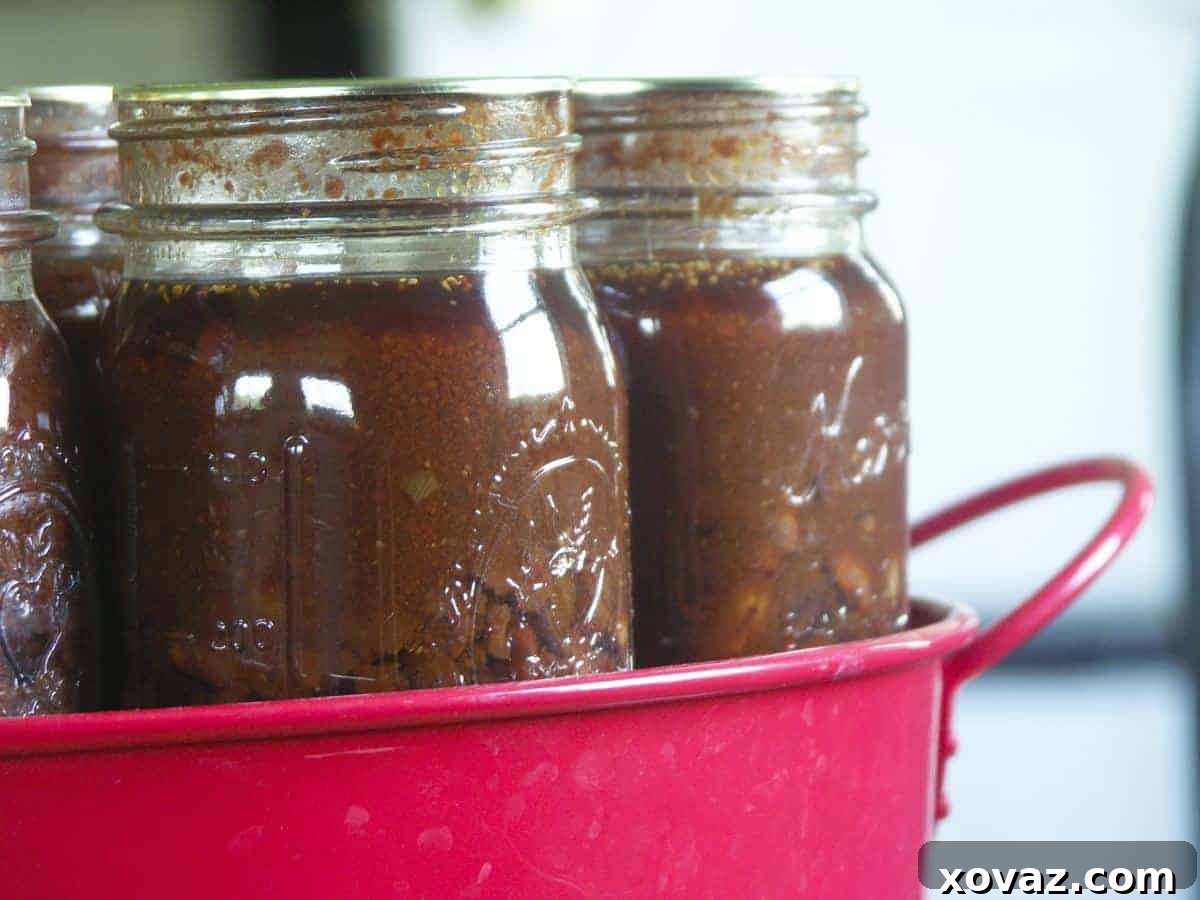
The hardest part of this entire project, I must admit, was the agonizing two-week wait after processing the jars before I could finally taste them. Their hermetically sealed jars, neatly lined on a basement shelf, seemed to beckon me with an irresistible culinary siren song: “Eat me!” But patience, as it turns out, is a virtue that pays off handsomely in the world of home canning.
Crafting Flavor in a Jar: The Art of Barbecue Beans
And boy, oh boy, are these beans good. There is absolutely no hint whatsoever of the paltry ten minutes of hands-on time – alright, twenty minutes if you count the essential steps of wiping and labeling the jars – that went into creating this masterpiece. These beans emerge smoky, spicy, and perfectly saucy, tasting as if they’ve simmered for hours upon hours in a slow oven, rather than poured from a jar that simply sat in the basement. The depth of flavor is truly remarkable, defying their simple preparation.
These Canned Barbecue Beans alone are reason enough to justify the price of a new pressure canner, even if they were the *only* thing you ever made in it. How can such a profound impact on flavor and convenience be possible from such a straightforward process?
The Busy Family’s Secret Weapon: Weeknight Dinners Made Easy
Let me paint a little mental picture for you, one that resonates with the chaotic rhythm of modern family life. Let’s say, hypothetically, you have five sons. (It could happen, you know.) And let’s imagine two of them are in a play, with rehearsal on Tuesday and the main show on Thursday. You have a column due Wednesday, paperwork at the bank on Thursday morning, and a house full of company arriving Friday for the weekend, expecting to share meals with you. Now, where in that whirlwind schedule are you going to find the time and energy to prepare a delicious, filling, and wholesome dinner for your guests?
Here’s your solution, tailored for convenience and flavor: Throw a pot of rice onto the stove. Open and reheat a couple of jars of your homemade Canned Barbecue Beans. Grill a few links of your favorite sausage – Kielbasa, smoked sausage, link-chorizo, whatever your preference. Toss together a fresh green salad. Fluff the rice, spoon the rich barbecue beans over it, top with the grilled sausage, and serve alongside the salad with something icy cold to drink. Dinner, effortlessly delicious and remarkably quick, is served. This scenario perfectly illustrates the profound impact home-canned goods can have on managing a busy household, transforming potential mealtime stress into a moment of calm and enjoyment.
Beyond Convenience: The Unmatched Benefits of Home-Canned Goodness
But wait, there’s more! These beans aren’t just convenient; they are incredibly economical. Buying dried beans in bulk and canning them yourself is dirt cheap – you simply cannot get food of this quality for anywhere near this price in any store. Furthermore, and perhaps most importantly, they are exceptionally good for you. Loaded with fiber, essential vitamins, and vital minerals, and completely free from funky preservatives or artificial additives, this is food as it was truly intended to be. You maintain complete control over the ingredients, ensuring that what you put into your body, and your family’s bodies, is nothing but wholesome goodness.
The benefits extend beyond the individual meal. Home canning contributes to greater food security, allowing you to build a well-stocked pantry that can sustain your family through various circumstances. It reduces food waste by preserving seasonal harvests, and it minimizes your environmental footprint by cutting down on packaged goods. There’s also immense satisfaction and a deep connection to your food when you’ve prepared and preserved it yourself. It’s a skill that blends tradition with modern efficiency, empowering you to nourish your loved ones with confidence and flavor.
For a printer-friendly version of this recipe, with no photos and sidebars, click here!
Canned Barbecue Beans
adapted from Creative Canning and Mary Kay Craig
- 1 pound (or slightly more) black beans or a mix of pinto and black beans, rinsed, picked over and soaked 8 hours or overnight
- 2 onions, peeled and small diced
- 5 small cloves garlic, minced
- 2 1/2 cups barbecue sauce (I used my favorite homemade Kansas City style sauce, but a high-quality bottled sauce will do the job beautifully in a pinch.)
- 2-3 drops liquid smoke per pint jar (adjust to your preference for smokiness)
- 1/4-1/2 teaspoon ground chipotle powder per pint jar, to taste, or 1/2 of a fresh jalapeño, minced, per pint jar (for an extra kick)
After the beans have soaked overnight, ensure they are thoroughly drained and rinsed. The mixture you see in the original content was an approximately equal by weight combination of black beans and pinto beans, demonstrating the flexibility of the recipe.
Carefully divide the soaked beans between five clean pint jars. The beans should comfortably fill the jars to about the halfway mark. Next, distribute the finely diced onions and minced garlic evenly among all the jars.
To infuse these beans with their signature flavor, add the specified amount of chipotle powder (or minced jalapeños for fresh heat) and liquid smoke to each individual jar. These ingredients are crucial for developing that rich, smoky, and spicy profile.
Then, add precisely 1/2 cup of your chosen barbecue sauce to each jar. You might notice that the pinto beans in a mixed batch tend to get stained by the black beans – this is a natural and inevitable occurrence, and absolutely nothing to worry about. It will not affect the taste or quality of your final product.
Finally, fill the jars with clean, fresh water, ensuring the liquid reaches within one inch of the top rim. This crucial headspace is vital for proper sealing and safe processing. Insert a chopstick or a narrow non-metallic tool into the bottom of each jar two or three times to release any trapped air bubbles. Adjust the liquid level if necessary to maintain that one-inch clearance from the upper rim. Carefully wipe the rims of the jars to ensure they are perfectly clean – any residue can prevent a proper seal. Apply new two-piece lids (flat lid and band) and process the jars according to your specific pressure canner’s manufacturer’s recommendations, typically at 15 pounds of pressure for 90 minutes. Always refer to your canner’s manual for precise altitude adjustments and processing times.
You might wonder, “How is it possible that you don’t have to cook the beans first?” This is where the true brilliance of pressure canning shines. Pressure canning is far more than just an efficient preservation method; it’s incredibly convenient. As the jars are being processed under high pressure and temperature, the beans inside are simultaneously being thoroughly cooked. It’s like a magical culinary shortcut, achieving perfectly cooked and preserved beans in a single, streamlined step.
Now comes the most challenging, yet crucial, part: the waiting game. You absolutely must wait at least two weeks for the beans to properly absorb the liquid and for the flavors to fully meld and develop within the jar. For the ultimate flavor experience, you could even extend this waiting period to four weeks, if you can stand the anticipation! However, I can almost guarantee that as soon as you open that first glorious jar, you’ll be so impressed, you’ll immediately want to prepare another batch.
P.S. A really neat phenomenon can occur with these jars. Because pressure canning creates a powerful vacuum inside the jars as they cool, the liquid contents can continue to boil long after they’ve been removed from the canner and are resting on the cooling rack. I’ve observed one jar’s contents actively boiling for a full thirty-five minutes after being taken out! The Evil Genius assures me that this is a perfectly normal and safe indicator of a strong seal and effective canning process.