Ring in the New Year: Southern Traditions, Black-Eyed Peas, and Recession Caviar
As the calendar flips to a new year, there’s a unique sense of anticipation and a clean slate brimming with possibilities. Here at Foodie with Family, we celebrate this transition not just with hopeful thoughts but with delicious food deeply rooted in tradition. To our cherished community who have journeyed with us throughout the year, thank you for your unwavering support. Connecting with each of you, hearing your stories, and seeing your culinary adventures has been an absolute delight and truly means the world to us. For those who are just discovering our corner of the internet, a warm welcome awaits! We sincerely hope you’ll pull up a chair, stay a while, and perhaps even join us for a virtual cup of tea. Your comments, questions, and shared recipes are the vibrant threads that weave the fabric of our days, always bringing a smile to our faces.
Embracing New Beginnings: Beyond Resolutions
Are you ready for a fresh start? A glistening New Year unfurls before us, presenting three hundred and sixty-five new opportunities to shape our lives exactly as we envision them. While many embrace the tradition of New Year’s resolutions, I confess to a slightly different approach. My independent spirit often finds itself at odds even with rules I set for myself! Instead of rigid resolutions, which I might inevitably abandon, I find inspiration in a different kind of guide: the timeless wisdom of Henry Wadsworth Longfellow’s “A Psalm of Life.” This poem, whose full text you’ll find below, offers a profound reflection on purpose and perseverance. One stanza, in particular, resonates deeply with me as each year begins:
“Let us, then, be up and doing,
With a heart for any fate ;
Still achieving, still pursuing,
Learn to labor and to wait.”
This powerful verse serves as my annual pep talk, gently steering my thoughts and intentions in a positive direction. As we bid farewell to the old year and greet the promising horizon of the new, I find myself drawn to two enduring comforts: poetry and food. Together, they offer sustenance—poetry for the romantic heart and food for the sensual palate. Indeed, what is a celebration without a feast to mark the occasion?
The Enduring Charm of Southern New Year’s Traditions
New Year’s celebrations, much like Thanksgiving or Christmas, come with their own set of cherished culinary traditions. Having married into a wonderful Southern family, and with both my maternal grandparents hailing from the Deep South, I’ve grown to appreciate the rich tapestry of customs that define this special time of year. In the South, New Year’s Day isn’t just another holiday; it’s a day steeped in traditions aimed at ensuring good fortune and prosperity for the year ahead. And at the heart of these traditions lies a humble yet mighty legume: the black-eyed pea.
The Symbolic Power of Black-Eyed Peas for Prosperity
The practice of eating black-eyed peas for luck on New Year’s Day is a deeply ingrained Southern tradition, believed to trace its roots back to the American Civil War era. Legend has it that during the war, Union troops often stripped the countryside of provisions, including stored food, crops, and livestock, destroying anything they couldn’t carry away. However, they reportedly left behind “field peas” (a category that included black-eyed peas) and field corn, considering them only suitable for animal fodder. This oversight proved fortuitous for many Southerners, who relied on these resilient foods for survival. Thus, black-eyed peas became a symbol of good fortune and resourcefulness.
Beyond historical anecdote, the black-eyed pea also carries a potent symbolic meaning: it is said to represent coins or monetary wealth. To amplify this wish for prosperity, Southern tradition often dictates pairing black-eyed peas with collard greens or other leafy greens, which symbolize paper money. The idea is that by beginning the year with these symbolic foods, you set a positive precedent for financial well-being throughout the coming twelve months. While the precise impact on your bank account may vary, starting the year with a delicious and budget-friendly recipe certainly can’t hurt!
Recession Caviar: A Culinary Gem for a Prosperous Year
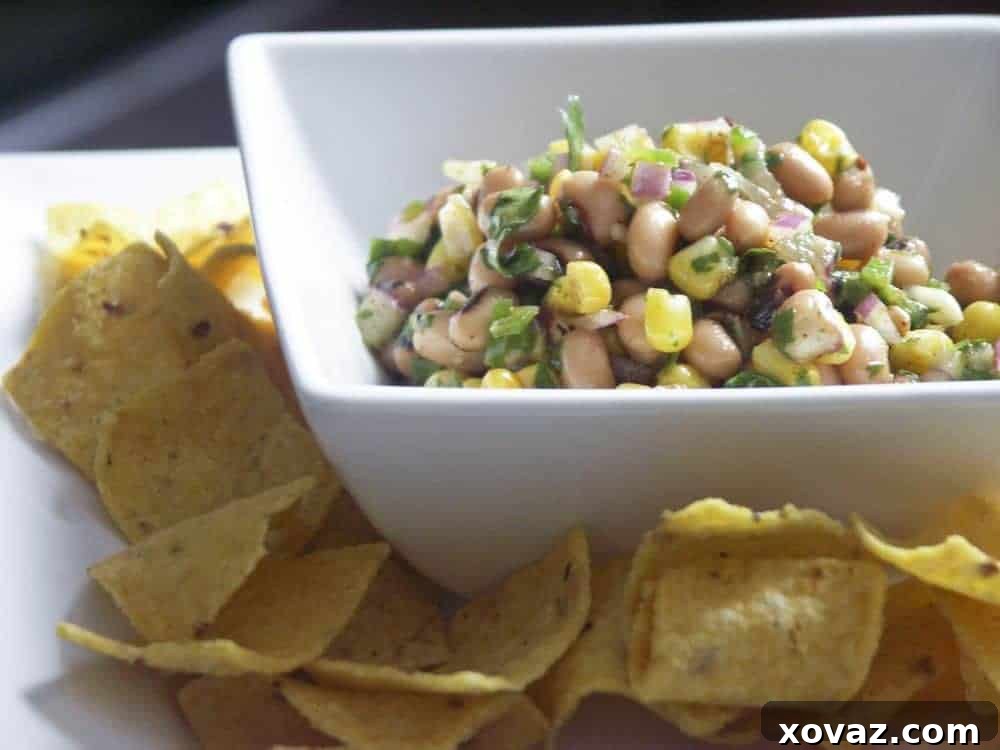
Long a staple in my family, this incredibly budget-friendly dish, affectionately known as “Recession Caviar,” is a testament to the power of simple ingredients transformed into something extraordinary. While we’ll be featuring the ubiquitous black-eyed peas for our New Year’s rendition, this versatile dish takes on many forms and names depending on the occasion and the region. You might know it as Lindamood Caviar, Hillbilly Caviar, or the widely popular Texas Caviar. No matter its moniker, its appeal is truly universal. I recently prepared a generous bowl of this vibrant concoction for a family gathering, delighting a diverse crowd of Virginians, Texans, Georgians, Floridians, and a few “Yankee” spouses (myself included!). The ultimate stamp of approval? An utterly empty bowl. This is a dish that transcends regional palates, offering big, bold flavors that everyone can appreciate.
Nourishment on a Budget: The Unsung Hero of Beans
True to its name, Recession Caviar is incredibly kind to your wallet. Beans—whether canned or dried—are a perennially inexpensive and profoundly nutritious source of protein, fiber, iron, and a wealth of essential vitamins and minerals. Pound for pound, beans are one of the most cost-effective and nutrient-dense foods you can incorporate into your diet. For those interested in the scientific specifics, the American Journal of Clinical Nutrition offers a wealth of information on the benefits of legumes and soybeans. But simply put, trust me: beans are remarkably good for you. They’re good for your heart, your digestive system, and your overall well-being. (And yes, after raising five sons, I’ve heard all the jokes. But seriously, the benefits outweigh any temporary…er… “musical” side effects!)
Beyond its budget-friendly nature, Recession Caviar is a versatile superstar at the dinner table, during snack time, or at any celebratory gathering. Its big, bold flavors and fresh, vibrant texture are sure to impress. Serve it simply with sturdy tortilla or corn chips, spoon it generously into burritos or atop tacos, or offer it as a colorful side dish alongside grilled fish, roasted chicken, or succulent pork. The beauty of this recipe lies in its adaptability: feel free to swap black-eyed peas for black beans or chili beans, and incorporate any other fresh vegetables you have on hand. Consider this recipe a delicious jumping-off point for your own culinary creativity!
Here’s a little secret: it’s not just tasty and economical; it’s genuinely good for you! Imagine ringing in the New Year with authentic Southern pride, satisfying your palate, impressing your guests, and keeping an eye on your waistline—all at the same time. Who loves ya, baby? We do! Now, let’s get cooking!
For a photo-free, printer friendly version of this recipe, click here!
Recession Caviar (Black-Eyed Pea Salsa) Recipe
Ingredients:
- 3 cans (14.5 ounces each) Black-Eyed Peas, thoroughly drained and rinsed
- 3 cups frozen corn, thawed to room temperature
- 1/2 of a large red onion, or more to taste, finely diced
- 1-4 fresh jalapeño peppers, stems removed, seeded, and minced, adjusting quantity for desired heat
- 1-4 cloves of fresh garlic, peeled and minced, according to preference
- 1 large handful of fresh cilantro, rinsed, patted dry, and roughly chopped
- 2 Tablespoons light olive oil or canola oil
- 1 Tablespoon chili powder
- The juice of two fresh limes (bottled lime juice can be used in a pinch)
- 1 teaspoon Kosher salt
- Freshly ground black pepper to taste
Instructions:
Prepare the Red Onion: Peel the red onion half. Lay it on its cut side and make parallel slices, about 1/8 to 1/4 inch apart, cutting almost all the way to the root end but leaving it intact to hold the onion together. Rotate the onion 90 degrees and slice across the previous cuts to create a small, even dice. Don’t worry about achieving perfect uniformity; the rustic charm is part of this dish’s appeal.
Combine Base Ingredients: In a large mixing bowl, combine the finely diced red onions, thawed corn, and the thoroughly rinsed and drained black-eyed peas. Add the minced garlic to this mixture. Set aside.
Prepare the Jalapeños: Carefully slice each jalapeño pepper in half lengthwise. Using the tip of a spoon, scoop out and discard the seeds and the white membranes; this is where most of the heat resides. If you prefer a spicier salsa, you can leave some of the membranes intact. Remove the stems.
Dice the Jalapeños: Slice the deseeded peppers into thin strips. Turn the strips 90 degrees and slice across them to finely dice the peppers.
Add Jalapeños to Bowl: Transfer the finely diced jalapeños to the mixing bowl with the black-eyed peas, garlic, and onions.
Add Remaining Ingredients and Mix: Roughly chop the fresh cilantro. Add the chopped cilantro, light olive oil (or canola oil), chili powder, fresh lime juice, Kosher salt, and freshly ground black pepper to the black-eyed pea mixture. Stir everything together thoroughly until all ingredients are well combined and coated with the dressing.
Chill and Serve: For best flavor, allow the Recession Caviar to sit, covered, at room temperature for at least one hour before serving. Alternatively, if preparing in advance, refrigerate for at least four hours (or preferably overnight) to allow the flavors to meld beautifully. Store any leftovers tightly covered in the refrigerator for up to 5 days.
~~~~~~~~ ~~~~~~~~
Inspiration for the Year Ahead: A Psalm of Life
As promised, here is one of my favorite timeless pieces of literature to reflect upon as we greet the New Year—a source of enduring strength and purpose.
A PSALM OF LIFE
by Henry Wadsworth Longfellow
WHAT THE HEART OF THE YOUNG MAN
SAID TO THE PSALMISTTELL me not, in mournful numbers,
Life is but an empty dream ! —
For the soul is dead that slumbers,
And things are not what they seem.Life is real ! Life is earnest!
And the grave is not its goal ;
Dust thou art, to dust returnest,
Was not spoken of the soul.Not enjoyment, and not sorrow,
Is our destined end or way ;
But to act, that each to-morrow
Find us farther than to-day.Art is long, and Time is fleeting,
And our hearts, though stout and brave,
Still, like muffled drums, are beating
Funeral marches to the grave.In the world’s broad field of battle,
In the bivouac of Life,
Be not like dumb, driven cattle !
Be a hero in the strife !Trust no Future, howe’er pleasant !
Let the dead Past bury its dead !
Act,— act in the living Present !
Heart within, and God o’erhead !Lives of great men all remind us
We can make our lives sublime,
And, departing, leave behind us
Footprints on the sands of time ;Footprints, that perhaps another,
Sailing o’er life’s solemn main,
A forlorn and shipwrecked brother,
Seeing, shall take heart again.Let us, then, be up and doing,
With a heart for any fate ;
Still achieving, still pursuing,
Learn to labor and to wait.