Visit our Bread Recipes page for more fantastic homemade breads!
Mastering Homemade Bao Buns: Your Guide to Fluffy, Flavorful Steamed Delights
For those who know me, my passion for food is unmistakable, and my lifelong fascination with Asian cuisine runs just as deep. As a food blogger, my mission is to demystify complex dishes, empowering home cooks to recreate restaurant-quality meals in their own kitchens. I love proving that dishes once thought too challenging are, in fact, incredibly accessible. Today, I’m thrilled to share one such culinary revelation: the exquisite Bao Buns, a beloved staple of dim sum culture.
Perhaps you, like me, have long dreamt of making these irresistibly soft, pillowy steamed buns, or maybe you’re just discovering their existence. Whichever category you fall into, prepare to be amazed. These tender clouds of dough are famously filled with succulent ingredients like braised pork belly, juicy grilled chicken, or other flavorful meaty morsels. You’re about to discover just how effortlessly you can craft these festive, fabulous, and utterly classic Bao Buns right from your own kitchen.
Unlock the Secrets with a Professional Chef’s Guide
To truly master the art of Bao Buns, nothing beats a visual demonstration. We’re incredibly fortunate to feature an invaluable step-by-step video tutorial by superstar Chef Mark O’Leary of Shojo Asian Bar & Bistro in Boston, Massachusetts. Chef O’Leary makes the entire process completely unintimidating, guiding you through each stage with expert precision. Don’t miss this opportunity to learn from the best!
CLICK HERE to watch the video!
Essential Cook’s Notes for Perfect Bao Buns
Making homemade Bao Buns is a rewarding experience, and with these expert tips, you’ll achieve perfect results every time. This dough, while seemingly simple, benefits from a few crucial insights that will elevate your buns from good to absolutely extraordinary.
- Precision in Flour Measurement is Key: While yeast doughs can sometimes be forgiving, achieving the perfect texture for Bao Buns truly benefits from accurate flour measurement. I cannot emphasize enough the advantage of measuring your flour by weight – the recipe below includes the exact ounce measurement for your convenience. If you don’t have a kitchen scale, opt for the “scoop-and-level” method: use a spoon to lightly scoop flour into your measuring cup until it’s overflowing, then use the flat edge of a butter knife or the back of a spoon handle to level it off without shaking or compacting the flour. This prevents over-packing, which can lead to a dense, tough bun. Measuring by weight, however, remains the quickest and most consistent path to success.
- Buttermilk Substitutions Made Easy: Chef O’Leary’s original recipe calls for cultured buttermilk, which undoubtedly yields fantastic results. However, if you find yourself, as I often do, staring at an empty buttermilk carton when inspiration strikes, don’t despair! Plain Greek yogurt makes an admirable substitute. Its similar acidity and thicker texture provide the necessary moisture and tenderizing qualities, ensuring your Bao Buns remain wonderfully soft and flavorful. Simply swap it out in equal measure.
- The Art of Rolling: Thickness Matters: When it comes to rolling out your dough, resist the urge to go too thin. While any thickness will technically produce an edible bun, to achieve those coveted lofty, airy, and pillowy Bao Buns, aim for a thickness of at least 1/2-inch. Rolling it thinner will result in a more delicate, less substantial bun that won’t have the desired fluffiness or capacity for ample fillings. Be mindful and consistent across all your dough rounds.
- Smart Dough Handling for Maximum Tenderness: Chef O’Leary’s advice on cutting circles is golden: cut them as closely together as possible. This minimizes waste and, more importantly, reduces the amount of re-rolling required for your dough scraps. Each time you re-roll dough, you’re “working” the gluten, which can make the finished product tougher. Therefore, always rest your dough scraps for at least 30 minutes after gathering them before re-rolling. This allows the gluten to relax, ensuring that subsequent buns are just as tender as the first batch. The less you work the dough, the more tender your Bao Buns will be – it’s a simple rule for exceptional results.
- Improvised Steaming Setups: No Wok? No Problem! Don’t let the lack of a traditional wok steamer deter you. A perfectly functional steaming setup can be fashioned with readily available kitchen items. A simple stainless steel vegetable steamer, the kind you can pick up at almost any general store, works wonders. Place this steamer into a deep-sided pot or pan (one with walls at least 5 inches high). To elevate the steamer above the water, invert three heat-safe ramekins or small, sturdy bowls in the bottom of the pan and rest the steamer’s feet on top of them. This creates the necessary space between the boiling water and your buns, allowing steam to circulate evenly and cook them to perfection. Always ensure your lid fits the pan well enough to trap steam but also allows a little steam to vent. The easiest way to achieve this is by leaving the lid slightly offset rather than sealing it tightly. This prevents excessive condensation from dripping onto your buns and ensures they expand beautifully.
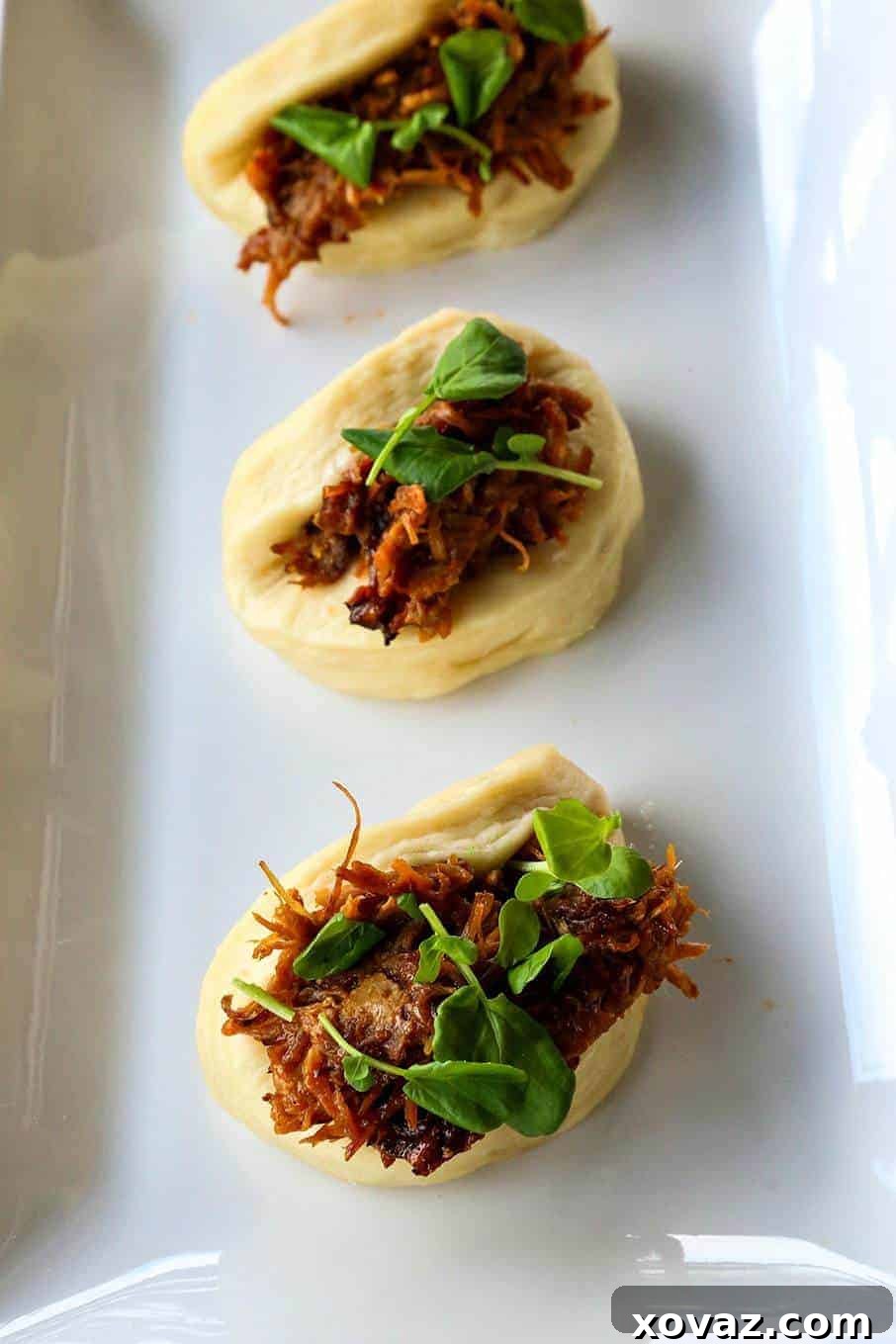
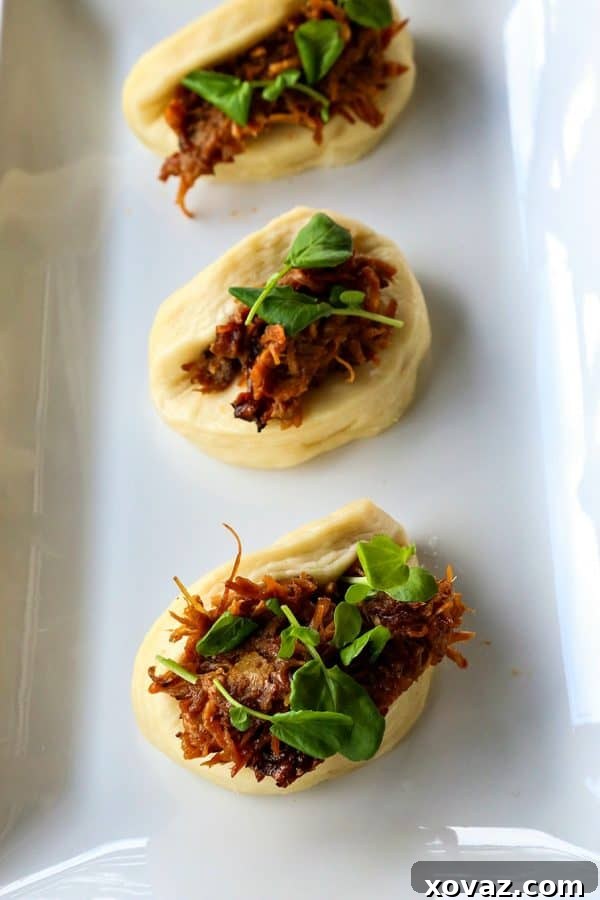
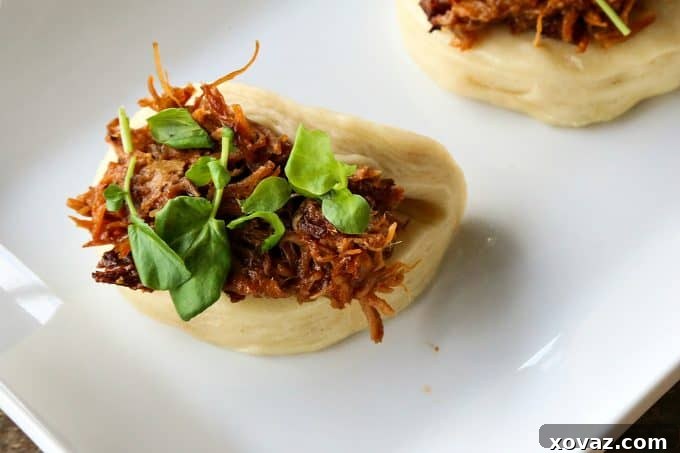
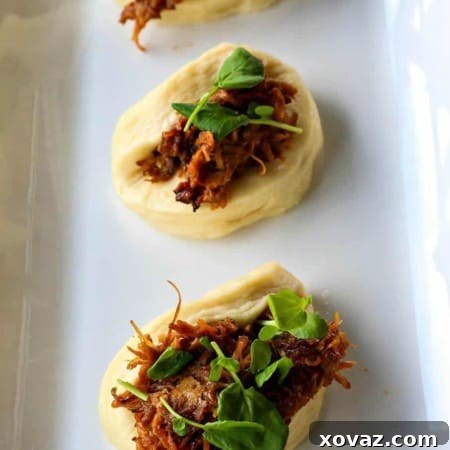
- Creative Fillings for Every Palate: While the classic pork belly is a universal favorite, the beauty of homemade Bao Buns lies in their versatility. You can truly fill them with whatever your heart (and taste buds) desires! My personal favorite, as pictured above, features succulent shredded pork generously tossed in a Korean barbecue sauce. Toppings add another layer of flavor and texture: a few sprigs of fresh watercress, a dollop of tangy homemade kimchi, some crisp refrigerator pickled vegetables, or delicate thin cucumber slices. This combination creates an appetizer or game day food that’s deceptively simple to prepare but delivers an impressively complex punch of flavor and texture. Explore grilled tofu, spicy chicken, sautéed mushrooms, or even sweet fillings for a dessert bun!
Make Bao Buns
Recipe by Chef Mark O’Leary, gentle adaptations by Rebecca Lindamood
Ingredients
- 3 1/2 cups all purpose flour (12 3/4 ounces, by weight)
- 1 tablespoon granulated sugar
- 1 teaspoon baking powder
- 1/2 teaspoon kosher salt
- 1 teaspoon instant yeast
- 1 cup warm water
- 2 tablespoons cultured buttermilk or Greek yogurt
- canola or sunflower oil (for coating)
- non-stick cooking spray (for parchment)
Instructions
- Prepare the Dough: In the bowl of a stand mixer fitted with a dough hook (or a large mixing bowl for hand kneading), add the all-purpose flour. Whisk in the granulated sugar, baking powder, kosher salt, and instant yeast until all dry ingredients are evenly distributed. In a separate bowl, whisk together the warm water and either cultured buttermilk or Greek yogurt. Pour this liquid mixture into the dry ingredients and mix on low speed (or with a sturdy wooden spoon) until a shaggy dough begins to form. If using a stand mixer, increase the speed one level and knead with the dough hook for approximately 5 minutes, or until a smooth, elastic dough is achieved. If mixing by hand, turn the dough out onto a lightly floured surface and knead until it becomes smooth and supple. Once kneaded, if using a stand mixer, simply remove the dough hook and cover the bowl with a clean towel. If kneading by hand, lightly flour a clean bowl, place the dough inside, and cover with a towel. Allow the dough to rest in a warm, draft-free place for 30 to 45 minutes, letting it slightly rise.
- Set Up Your Steamer: While the dough is resting, prepare your steaming apparatus. You can use a traditional wok with a stacked steamer, or construct a makeshift setup using a stainless steel vegetable steamer placed inside a deep pot (one with walls at least 5 inches high). Whichever pot you choose, add about an inch of water to the bottom – enough to boil for an extended period without bubbling up through the bottom of your steamer. It’s crucial to maintain adequate space between the water and where your Bao Buns will sit to ensure proper steaming. For the makeshift setup, consider placing three heat-safe ramekins upside down in the bottom of the pot to elevate the vegetable steamer, ensuring your buns are well above the boiling water level.
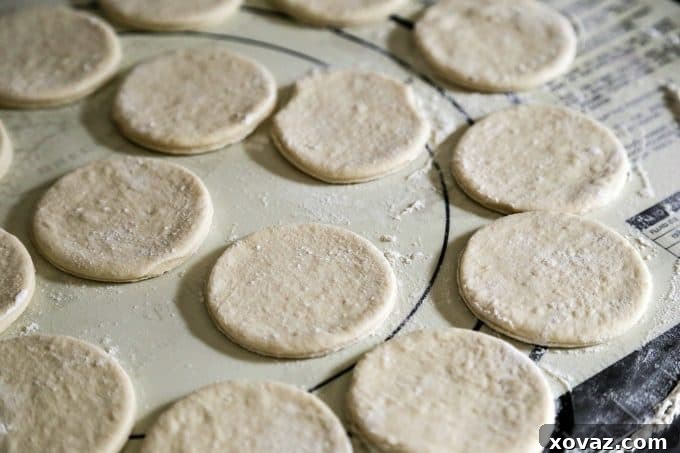
- Roll and Cut the Dough: Generously flour a clean counter surface or a dough mat. Carefully turn the rested dough onto the floured surface and lightly dust the top of the dough with more flour. Using a rolling pin, place it in the center of the dough and roll away from yourself. Lift the rolling pin, return it to the center, and roll towards yourself. Next, turn the dough 90 degrees or rotate your rolling pin perpendicular to your body, place it in the center, and roll towards the right, then lift and roll towards the left. Take a moment to gently slide the dough around to ensure it’s not sticking to the surface. Repeat these rolling motions until the dough is uniformly 1/2-inch thick. Dip a round cookie cutter (approximately 3-4 inches in diameter is ideal for standard Bao Buns) in extra flour to prevent sticking, then press it straight down into the dough. Give it a slight twist at the bottom to ensure a clean cut. Lift the cutter, redip in flour, and continue cutting as many circles as possible, arranging them closely to minimize scraps. Once you’ve cut all possible circles, gather the remaining dough scraps, press them gently together, and return them to the bowl. Cover them again with a towel and let them rest for at least 30 minutes before re-rolling and cutting more circles. This resting period allows the gluten to relax, ensuring the re-rolled dough remains tender.
- Shape the Bao Buns: Using the back of a spoon or a pastry brush, lightly coat one half of each circular dough round with canola or sunflower oil. This oil layer prevents the two halves from sticking together completely, allowing you to open the bun later for filling. Carefully fold the uncoated half of the dough over the oiled half, creating a semi-circle shape. Press gently along the curved edge to seal lightly, but leave the straight edge open to form the “pocket” of the bun.
- Steam the Buns: Line your steamer basket (whether a wok steamer or your improvised setup) with a rectangle of parchment paper, ensuring it’s generously coated with non-stick cooking spray to prevent sticking. Gently arrange the folded Bao Buns onto the parchment paper, leaving at least 1/2-inch of open space around the perimeter of each bun. This is crucial as the buns will expand significantly during steaming. Place the lid securely on the steamer, or if using a pot, ensure the lid is slightly askew to allow a little steam to vent. Steam the buns for precisely 6 minutes. Avoid lifting the lid during this time. Once steamed, carefully transfer the beautifully puffed Bao Buns to a plate. Repeat the process with the remaining bun semi-circles.
- Serve and Enjoy: Fill your freshly steamed Bao Buns as desired with your choice of savory or sweet fillings. While they are delicious at any temperature, Bao Buns are best enjoyed within an hour of being steamed, preferably while they are still warm and wonderfully soft.
Nutritional information provided is an estimate and offered as a courtesy. You should calculate the nutritional information with the actual ingredients used in your recipe using your preferred nutrition calculator.
Did you make this recipe?
We’d love to see your creations! Make sure to tag @foodiewithfam on Instagram and use the hashtag #foodiewithfamily so we can check it out and share your delicious success!