Savoring Memories: Crafting the Perfect Potstickers to Keep Tradition Alive
The Unbreakable Bond of Tradition
Tradition – that inexplicable force that weaves threads through generations, creating a rich tapestry of shared experiences. It’s the invisible glue that binds us, offering comfort, identity, and a profound sense of continuity in an ever-changing world. Consider the universal rituals that mark our calendars: an entire nation roasting turkeys with unwavering dedication on the fourth Thursday of November, or lighting up the skies with celebratory grills on the Fourth of July. Without the deep-seated power of tradition, how would we rationalize hundreds of eager individuals gathering annually in a quaint Pennsylvania town, patiently awaiting a small ground-dwelling mammal to emerge from its burrow on the second day of February?
Yet, tradition isn’t merely about grand national holidays or quirky communal events. Its influence extends deeply into our personal lives, shaping our identities and the way we are perceived by others. Whether embraced or rejected, traditions form a significant part of our personal narrative, serving as a collective cultural memory that defines communities and individuals alike. They are the landmarks of our lives, the familiar touchstones that guide us through our personal histories.
On a much more intimate level, traditions are the fertile ground from which our most cherished family moments blossom. Weddings, funerals, Christmases, Independence Days, Thanksgivings, Easters – these pivotal occasions are often spent gathered around a table, surrounded by loved ones, partaking in customs that have been passed down or lovingly created. These are the moments that truly define ‘family,’ etched into our hearts and minds for years to come.
Kam Wah: A Chapter in Our Family Story
When my husband, whom I affectionately call The Evil Genius, and I began dating seriously – a phase quite distinct from our initial, more humorous courtship – we enthusiastically adopted a beautiful tradition from his family: weekly dinners at the Kam Wah Chinese Restaurant in Penfield, New York. The Lindamood Viking Horde, as they were known, had frequented Kam Wah since my husband’s junior year of high school. Given that he had established his “Evil Empire” long before I entered his orbit, you can imagine the significant span of time this tradition encompassed. The Evil Father-In-Law shared a cherished friendship with the restaurant’s owner, Mr. Wong, affectionately known to all as Uncle Wong. From my very first visit, Uncle Wong and his incredible staff welcomed me into the fold, treating me not just as a guest, but as a genuine member of the Lindamood Horde. This warm embrace often included delightful off-menu items, like Vicki’s renowned Dumpling Dipping Sauce and generous samples from Uncle Wong’s personal, homemade kimchi stash – true tokens of his hospitality.
As the years unfolded, Kam Wah became an indispensable backdrop to the most significant milestones of our lives. It was where we celebrated our engagement, sharing dreams over plates of delicious food. Our first dinner as a married couple, fresh from our honeymoon, was naturally spent there, basking in the glow of new beginnings. Each time we discovered we were expecting a child – our first, then second, third, fourth, and ultimately, our fifth – Kam Wah was our chosen spot to share the joyous news and anticipate the future. We toasted to buying our first home within its familiar walls, marking every major life event, big or small. Indeed, it was our go-to destination whenever we wanted to treat ourselves to an exceptional meal or impress cherished friends and family we took out to eat. The restaurant wasn’t just a place to dine; it was a living, breathing part of our family’s evolving story.
Our growing family continued to frequent Kam Wah on a semi-regular basis. As our brood expanded with each new arrival, the logistical challenges of dining out certainly increased, but we made it a point to visit after each baby was born. Uncle Wong, with his boundless kindness, would insist that we eat unencumbered, taking the babies into his arms to carry them around and proudly show them off to the other diners while we savored our meal. The wall near the cash register gradually accumulated a collection of charming pictures drawn by and treasured photos of our children, a testament to our deep connection. In short, we weren’t just customers; we were family, ingrained in the very fabric of Kam Wah.
The Unthinkable Closure: A Tradition Lost
Then, two fateful years ago, the unimaginable happened. The Evil Genius delivered the news: his brother, The Slightly-Less-Evil Lewis, had called to report that Kam Wah’s had reportedly closed. My initial reaction was pure disbelief; “He must be wrong,” I declared to my husband, even as my fingers frantically dialed Kam Wah’s phone number. No answer. I called again. Still no answer. A third attempt yielded the same disheartening silence. At this point, you might consider my behavior bordering on stalking, but wait – there was more! Driven by a desperate need for confirmation, I dispatched my husband forty minutes out of his way on his morning commute to personally check the restaurant. His report back was devastating: the doors were locked, the lights were out, and a small, stark sign on the door confirmed its closure. I went into a state of profound shock.
I immediately called The Evil Father-In-Law in Florida, who was, predictably, just as shocked and saddened. He quickly tried Mr. Wong’s home phone. It took us a agonizing two weeks to finally unravel the mystery behind Uncle Wong’s decision. The reason, when it finally emerged, felt utterly ridiculous to us: he was old and simply wanted to retire. “Pshaw! Unkind!” was my indignant thought. The cruelest twist was that he hadn’t informed any of his loyal regulars because he anticipated, correctly, that we would try to persuade him otherwise. The thought of losing access to my beloved potstickers with Vicki’s sauce, the comforting House Special Soup brimming with deep-fried filled wontons, the flavorful pork shreds in garlic sauce (always with extra broccoli, please!), and the perfectly crispy sesame beef (extra crispy, please!), all accompanied by a bowl of Uncle Wong’s signature kimchi, was unbearable. My children mourned the absence of the tiny paper umbrellas and the special bags of sweets Uncle Wong unfailingly sent home with them after every visit. And for The Evil Genius, it was the loss of his extra-spicy Szechuan beef and shrimp, and more profoundly, the loss of the very restaurant that had been inextricably woven into every major event of his adult life. The bitterest pill was that we hadn’t even been given a chance to lobby Uncle Wong to change his mind. (And I had such persuasive lines ready! How about this gem: “Retire? You can rest when you’re dead! I want my dinner!”) But alas, no dice. He remained retired, Kam Wah’s stayed closed, and I, quite literally, stayed hungry.
The Quest for the Perfect Potstickers
In the past two years, following a rather personal journey through four of the widely recognized five stages of grief over the closure of my favorite restaurant, I’ve finally arrived at stage five: acceptance*. And hand-in-hand with this acceptance came a fierce desperation. More than anything, I needed that food. My culinary obsession, specifically for the perfect potstickers, began in earnest. To my mind, no other dish was more intrinsically linked to the spirit and flavor of Kam Wah’s than their exquisite potstickers.
My quest led me to every brand available at our local (and by “local” I mean a dedicated hour-and-a-half drive away) Asian foods market. I sampled countless varieties, meticulously assessing each one. While many were objectively good, none quite captured the “just right” essence of Kam Wah’s. My stubborn nature simply wouldn’t allow me to settle for merely “okay.” The memory of those perfect dumplings fueled my relentless pursuit.
*My version of acceptance, anyway. In this optimistic interpretation, I acknowledge that Uncle Wong has indeed retired, but I also firmly accept that he could, at any given moment, have a change of heart and decide to reopen the restaurant. That works, right?
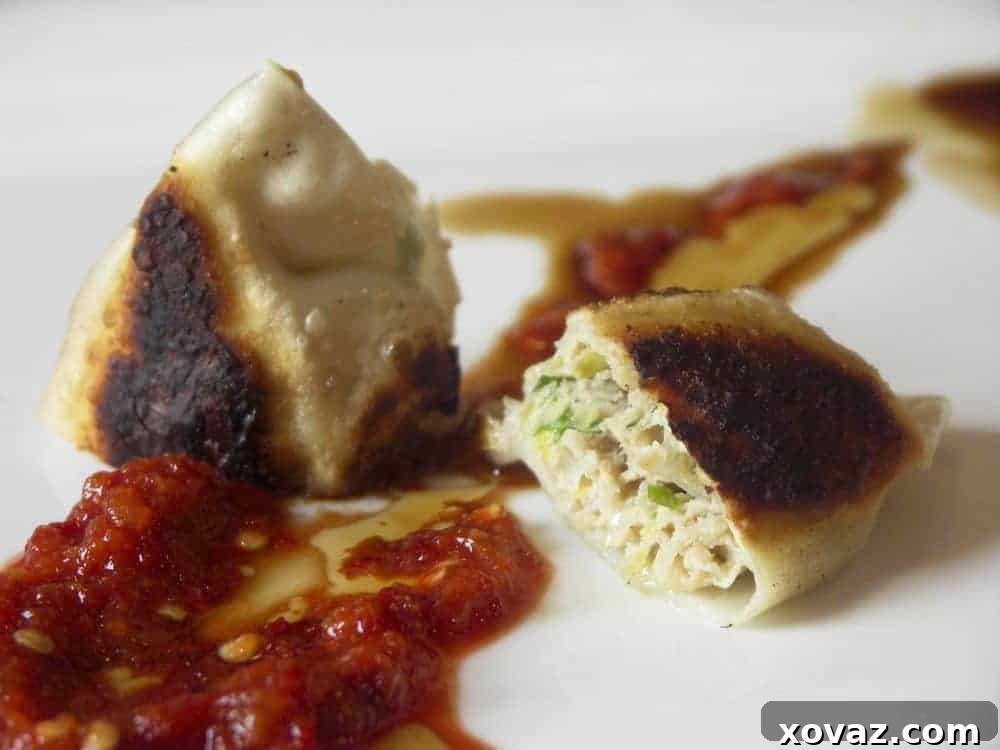
Potstickers, in all their perfection, even began to fill my dreams. I envisioned their ideal form: steaming hot, with a wonderfully crisp-bottomed exterior contrasting with a soft, yielding top. Each dumpling would be generously filled with moist, savory meat, infused with the vibrant flavors of ginger and garlic, and speckled with tiny, refreshing bits of Chinese cabbage and scallions. When served with a rich chili-garlic sauce, a splash of soy sauce, and fragrant sesame oil, or perhaps nestled on a bed of Momofuku’s Ginger Scallion Mother Sauce, there is, quite simply, no food more satisfying in all the world. Salty, crispy, meaty, intensely garlicky, warmly gingery, and delightfully scallion-y – they are the ultimate expression of umami, a truly profound culinary experience.
Recreating the Magic: My Chicken and Pork Potstickers Recipe
I could easily claim that I slaved tirelessly over this recipe, experimenting with bazillions of different combinations, but I won’t. (Though I will now proceed to charmingly contradict myself from three paragraphs ago.) The truth is, this particular formulation arrived surprisingly close to the cherished flavors I remember from Kammie’s dumplings, so I’ve resisted the urge to tinker too much. While I do make small, incremental alterations each time I prepare them, each adjustment brings me one step closer to absolute perfection. This specific combination is, without a doubt, the closest I have ever come to replicating the authentic Kam Wah recipe. I strongly suspect their secret involved using all ground pork with a subtle addition of minced shrimp, an attempt I haven’t yet gotten around to. But in the meantime, this recipe is truly great. It’s utterly delicious, embodying everything a dumpling should be – shy only of being lovingly crafted by the master chefs at Kam Wah themselves.
Developing this Chicken and Pork Potsticker recipe has allowed me to set in motion another wonderful tradition I’ve long intended to start: Chinese food on Christmas Eve. This particular custom I lovingly borrowed from our dear friends, the Wilsons. For as long as I’ve known them, their Christmas Eve has been synonymous with Chinese takeout. It’s a tradition I can firmly plant myself behind, embracing its delicious practicality. However, given the unfortunate dearth of truly decent Chinese food options in our tranquil Amish country, I find myself entirely on my own. The food, if it is to exist at all, must be made by me, with my own two hands.
One of the most appealing aspects of making these potstickers from scratch is their incredible versatility: you can effortlessly prepare the dumplings ahead of time and freeze them. Then, whenever the craving strikes or an occasion calls, you simply pull out as many as you desire from the freezer, heat your pan, and fry these little beauties to golden perfection in under ten minutes. If that doesn’t sound like the ideal prelude to a festive night filled with present wrapping and joyous stocking stuffing, then I honestly don’t know what does! This year, I’ve even playfully informed my kids that they stand to receive cooler presents if they opt to leave out a plate of these irresistible potstickers for Santa instead of the usual cookies. “Hey, Santa baby, check these out!”
For a photo-free, printer-friendly version of this recipe, click here!
Chicken and Pork Potstickers Recipe
These homemade Chicken and Pork Potstickers capture the authentic flavors of our favorite Chinese restaurant. Perfect for family meals or holiday gatherings, they offer a delicious taste of tradition.
Ingredients:
- 1 pound ground pork
- 2 pounds ground chicken
- 1 small head Chinese, Napa, or Savoy cabbage, very finely minced
- 1-1/2 bunches green onions, thoroughly washed and trimmed of roots and any dry ends
- 8 cloves garlic, freshly minced or pressed
- 1/4 – 1/2 cup peeled, finely minced or grated fresh ginger root (adjust to your preference for ginger intensity)
- 1/4 cup soy sauce
- 1 Tablespoon dark sesame oil
- 1 teaspoon fish sauce (for an extra depth of umami)
- 1 package dumpling (gyoza) wrappers (typically 50-60 count)
- 1 teaspoon cornstarch mixed with 1 Tablespoon cold water (for sealing)
Instructions:
-
Prepare the Green Onions: Lay the washed and trimmed green onions flat on your cutting board. If you encounter onions with particularly large bulb ends, you may wish to cut them in half lengthwise before slicing to ensure uniformly small pieces. Slice the green onions thinly on an angle for both visual appeal and even distribution of flavor.
Set the prepared green onions aside for later use.
-
Combine Meats and Aromatics: In a large mixing bowl, combine the ground pork, ground chicken, minced garlic, fresh ginger, soy sauce, dark sesame oil, and fish sauce. Using your hands, gently but thoroughly mix all the ingredients until everything is evenly distributed. Be careful not to overmix.
-
Optional: Reserve Filling: At this stage, if you have any “anti-vegetable” diners in your household, you may wish to pull out about a cup of this un-vegetated filling to prepare separately for them.
-
Add Cabbage and Green Onions: Add the finely minced cabbage and sliced green onions to the meat mixture. Continue to thoroughly combine by hand until all the vegetables are evenly mixed throughout the filling.
-
Prepare Dumpling Wrappers: Have you ever purchased dumpling wrappers before? This is what the packages typically look like at my favorite Asian market, usually found in the refrigerated section.
-
Fill the Wrappers: Take one dumpling wrapper and mound approximately 1-1/2 teaspoons of the prepared filling into its center.
-
Moisten Edges: Dip a fingertip into the cornstarch and cold water mixture, then lightly rub it along the entire edge of the dumpling skin. This creates a seal.
-
Form the Base Shape: Gently pull both sides of the wrapper up, creating a “taco” shape around the filling. Pinch together the excess dumpling skin at the very top, forming a tight seal.
-
Remove Air: While firmly pressing the sides together, try to squeeze as much air out of the dumpling as possible. Removing the air prevents the dumplings from bursting open during cooking.
At this point, your dumpling will bear a striking resemblance to a pierogi. This is compelling proof that virtually every culinary tradition boasts a delicious stuffed dough creation – be it pierogies, potstickers, or ravioli. The universal appeal of dough-wrapped goodness is undeniable!
-
Create Pleats: Once the dumpling is completely closed and sealed, begin in the center. Gently pull and fold a small pleat of the pinched dumpling skin toward the middle. Pinch it firmly to ensure it sticks.
-
Continue Pleating: Continue by forming two more pleats on that same end of the dumpling, working your way outwards.
-
Repeat on Other Side: Repeat the pleating process in the opposite direction on the other end of the dumpling. Place the finished dumpling on a lightly floured cookie sheet to prevent sticking.
-
Batch and Store: Continue making as many dumplings as your filling and wrappers will allow. You have several options for storage: you can freeze the finished dumplings directly on the cookie sheet until solid, then transfer them to a freezer-safe zipper-top bag for long-term storage. Alternatively, you can cook them immediately. Any leftover filling or wrappers can also be tightly wrapped and frozen for your next delightful batch of dumpling making.
To Cook the Dumplings:
Achieving that signature crisp bottom and tender, steamed top is the hallmark of a perfect potsticker. Follow these steps for optimal results:
-
Heat the Pan: Pour one tablespoon of a neutral oil (such as Canola, Vegetable, or Peanut oil) into a heavy non-stick skillet equipped with a tight-fitting lid. Place the pan over medium-high heat. Once the oil is hot and shimmering, swirl the pan to ensure the entire bottom surface is coated.
-
Arrange Dumplings: Carefully place several dumplings in the hot pan, taking care not to overcrowd it. Allow sufficient space between each dumpling for even cooking.
-
First Fry: Fry the potstickers undisturbed for three minutes. This initial frying develops that coveted crispy, golden-brown bottom.
-
Steam: Carefully add 1/2 cup of warm water to the pan and immediately place the lid on tightly. The water will quickly turn to steam, cooking the dumplings through. If you are cooking fresh potstickers, steam with the lid on for 5 minutes. If you are starting with frozen potstickers, increase the steaming time to 8 minutes to ensure they cook completely.
-
Crisp Again: Once the steaming time is complete, remove the lid. Continue to cook for an additional 1-2 minutes. This crucial step allows any residual moisture to evaporate and ensures the potstickers crisp back up beautifully on the bottom, achieving that perfect textural contrast.
-
Serve: Serve your delicious potstickers immediately with your desired condiments. We particularly enjoy chili garlic sauce, classic soy sauce, Sriracha, and the sweet-chili Mae Ploy sauce. Experiment to find your family’s favorites!