
If you’re eager to master the art of baking perfect homemade buttermilk biscuits, explore our extensive collection of bread recipes for more delicious ideas.

How to Make Flaky Buttermilk Biscuits: A Guide to Perfection
There are moments in life when only the warm, comforting embrace of a freshly baked biscuit will do. While quick “drop biscuits” can offer a passable substitute when time is short, they simply can’t compare to the ultimate satisfaction of a truly magnificent, cloud-like biscuit. What we often crave isn’t just any biscuit, but a towering, flawlessly flaky, richly layered, and exquisitely golden-brown masterpiece. Imagine a biscuit so tender you can effortlessly pull it apart with your fingers, ready to be adorned with a generous dollop of cold butter and sweet strawberry jam, or smothered in savory sausage gravy. This is the biscuit dream, and today, we’re going to make it a reality.
For years, my homemade buttermilk biscuits were undeniably good, thanks to a cherished recipe from my Arkansas-born grandma, an extraordinary cook. Her wisdom formed the foundation of my biscuit-making journey. However, my technique truly transformed after attending a King Arthur Flour baking demonstration and later their Blog & Bake event. These experiences unveiled a few revolutionary methods that elevated my already good biscuits to an entirely new level of perfection, creating what I proudly call “The One Biscuit to Rule Them All.” Prepare yourself, because these truly are the best buttermilk biscuits you’ll ever bake.

So, what are these “magical” techniques that promise such extraordinary results? While some might initially sound a bit particular, I assure you, each step plays a vital role in achieving that coveted flaky, layered texture and rich flavor. I’ll summarize them first, and then delve deeper into the “why” behind each one, demystifying the path to perfect homemade biscuits.
Essential Techniques for Perfect Buttermilk Biscuits
- Use COLD Butter: This is non-negotiable. Your butter must be thoroughly chilled, straight from the refrigerator. Do not allow it to soften at room temperature.
- Cut Butter into Two Shapes: Divide your cold butter into both thin pats and small cubes before incorporating it into the flour. This dual approach is key to texture.
- Work Butter by Hand: Resist the urge to use knives, forks, pastry cutters, or food processors. Your fingertips are your best tools for gently working the butter into the flour.
- Add Buttermilk Gradually: It’s always easier to add more liquid than to remove it. Be conservative with your buttermilk addition to avoid over-hydrating the dough.
- Handle Dough Gently: Biscuits thrive on a light touch. Avoid overworking or aggressively handling the dough, which leads to toughness. Stay relaxed – happy dough makes happy biscuits!
- Employ a Sharp Biscuit Cutter: A dull edge will seal the biscuit layers. Use a cutter with a sharp edge; avoid repurposed items like jars or glasses unless their edges are genuinely sharp.
- Cut Straight Down: When cutting biscuits, press the cutter straight down and lift it straight back up. Never twist or spin the cutter, as this will prevent proper rising.
- Maximize First Cuts: Get as many biscuits as possible from the initial rollout of dough. Each subsequent re-rolling and re-cutting will result in progressively tougher biscuits.
- Ensure Pan Spacing: Give each biscuit ample room on the baking sheet to expand. Crowding the pan will inhibit their rise and prevent beautiful, layered sides.
These are the fundamental rules. Now, let’s explore these principles in more detail, uncovering the secrets to making the best flaky buttermilk biscuits.
The Science Behind Homemade Buttermilk Biscuits: Butter is Key
When I say that cutting your butter in two different ways is one of the main secrets to perfect biscuits, I am not exaggerating. As you glance at the photos in the full recipe, you might notice a double batch in progress – because, well, biscuits!
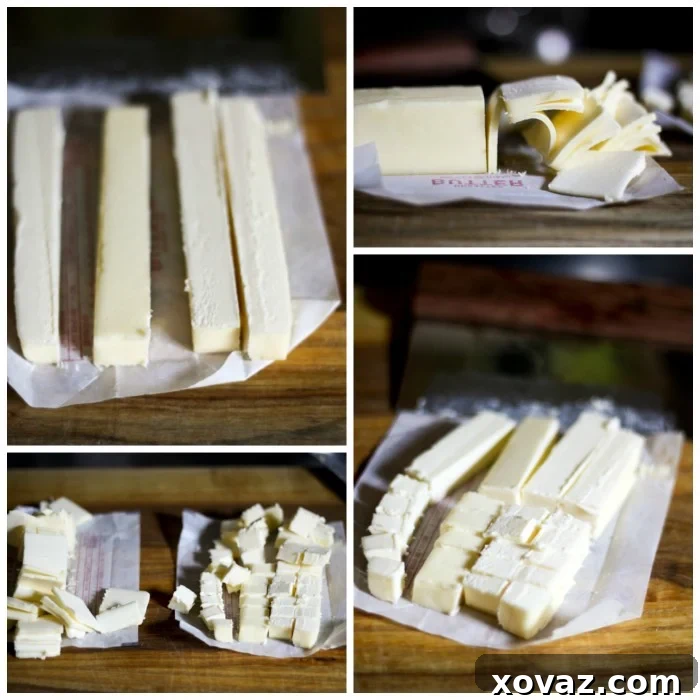
Observe closely: approximately half of the **super cold butter** is sliced into paper-thin pats, while the other half is first cut into long batons, then crosswise into small cubes. This isn’t just for show; there’s a precise scientific reason behind this technique. You see, you don’t want uniformly sized “chunks” or homogenous pockets of butter throughout your biscuit dough. Smaller pieces of butter contribute to a tender dough, melting evenly to create a rich flavor profile. Conversely, larger, flatter pieces are responsible for the prized flakiness, creating steam pockets as they melt in the hot oven, which then push the dough upwards, separating it into distinct layers.
Both tenderness and flakiness are hallmark traits of exceptional buttermilk biscuits. By starting with butter in these two distinct shapes and sizes, you are laying the groundwork for a biscuit that delivers on both fronts, ensuring a perfect balance of texture and taste.
The importance of using **cold butter** cannot be overstated. When butter is cold, it remains solid during the mixing process. It only begins to melt when it hits the high heat of the oven. The longer the butter takes to melt within the dough, the more steam it generates. This steam is what creates those magnificent, airy layers that define a truly perfect homemade buttermilk biscuit. If the butter melts too early, either from warm hands or room temperature conditions, it simply incorporates into the flour, resulting in a dense, tough biscuit without any discernible layers.
This recipe ingeniously uses **self-rising flour**, which simplifies the process by eliminating the need to add separate leavening agents like baking powder and salt. All you need to do is measure the self-rising flour into a spacious mixing bowl, and then introduce your perfectly prepared cold butter.
Now, it’s time to get your hands dirty – in the best way possible. Dip just your fingertips into the flour and butter mixture. Use a light, delicate touch to pull apart the butter pieces, tossing them gently with the flour. **Crucially, avoid using the palms of your hands.** Your palms radiate a significant amount of heat, which will quickly melt the butter. As we’ve learned, melted butter equals tough biscuits. And nobody wants tough biscuits, do they? The term itself sounds like an insult!
Years ago, my 13-year-old helped me create a short video to illustrate this technique more clearly. While you might hear some lively background noise – a testament to a real home where real food is shared with real children who adore these biscuits – it beautifully demonstrates the correct method for incorporating butter by hand.
This brings us to a critical point:
Why Use Your Hands to Mix Buttermilk Biscuit Dough?
The reason is wonderfully simple: your hands provide an unparalleled “feel” for the dough. When your fingertips are directly in contact with the mixture, you can instantly discern if any butter pieces are too large, or if the dough is too dry or too wet. This sensory feedback allows you to adjust your technique in real-time, ensuring you don’t overwork the dough – a common culprit behind those dreaded tough biscuits. You’ll intuitively know when the dough has achieved the right consistency, preventing the very act of “beating the tar out of it.”
When you first turn the dough out of the bowl, I promise you, it will look a bit “shaggy.” In fact, it might look *very* shaggy. If you’ve struggled with biscuits in the past, this stage might make you question everything, perhaps even my sanity. You’ll likely feel a strong urge to add more buttermilk, believing the dough is too dry. **Resist this temptation!** Trust the process. This seemingly “wrong” appearance is precisely what you’re aiming for.
Building Layers: The Art of Folding Biscuit Dough
The next essential step for achieving those magnificent layers is patting out and folding the dough. This simple yet powerful technique is what transforms a shaggy mass into a layered marvel.
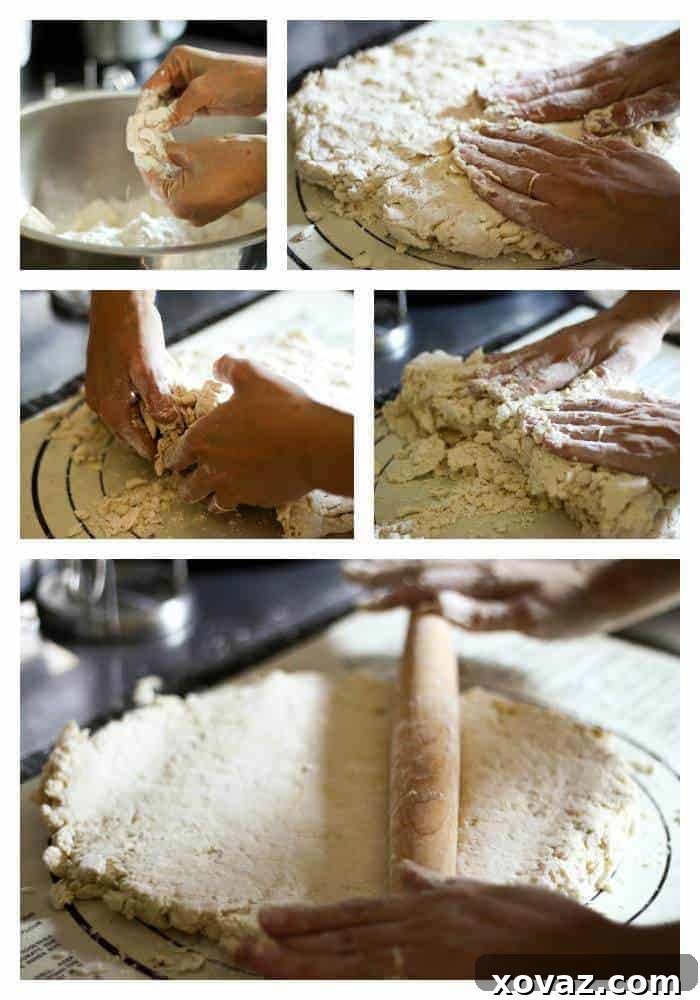
Here’s the straightforward method:
Imagine your dough as a clock face. Slide both hands underneath one side of the dough, around the 9 o’clock position. Gently lift that side and fold it over towards the 3 o’clock position, as if you’re closing a book. Lightly pat the folded dough back into a rectangle, aiming for about 2 inches in thickness. Next, slide your hands under the bottom of the dough, at the 6 o’clock position, and fold it upwards towards 12 o’clock. Repeat this entire sequence: patting it into a 2-inch rectangle, folding from 9 to 3, patting again, and then folding from 6 to 12. With each fold and pat, you’ll notice the dough holding together a little better, and you’re actively creating the internal layers that will define your flaky biscuits.
Once you’ve completed the folding, it’s time for a very gentle roll. Just like every preceding step, use a light hand. The dough should not require much effort to roll out. Aim for a thickness of about 3/4-inch to 1-inch, depending on how tall you like your biscuits.
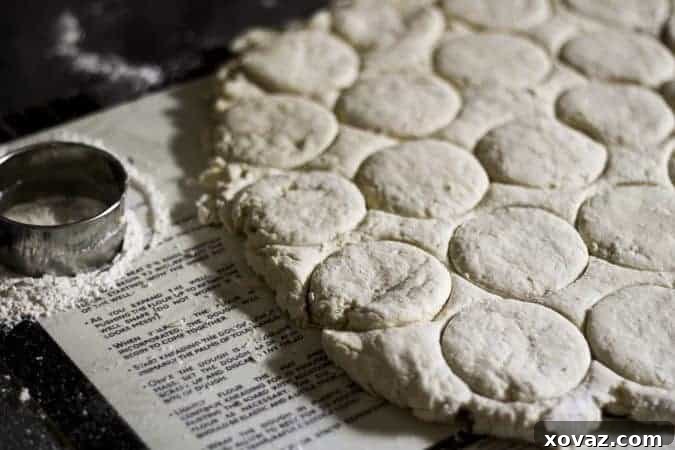
Now for the cutting. You have a couple of options: a good, sharp, open-topped biscuit cutter, or a sharp knife. Whichever tool you choose, the technique is paramount: **push the cutter or knife straight down** onto your work surface. Do not twist the cutter or saw the knife back and forth. Twisting or sawing will seal the delicate layers you’ve worked so diligently to create, preventing the biscuits from rising to their full, magnificent height. Straight down, straight up – that’s the golden rule for cutting perfect biscuits.
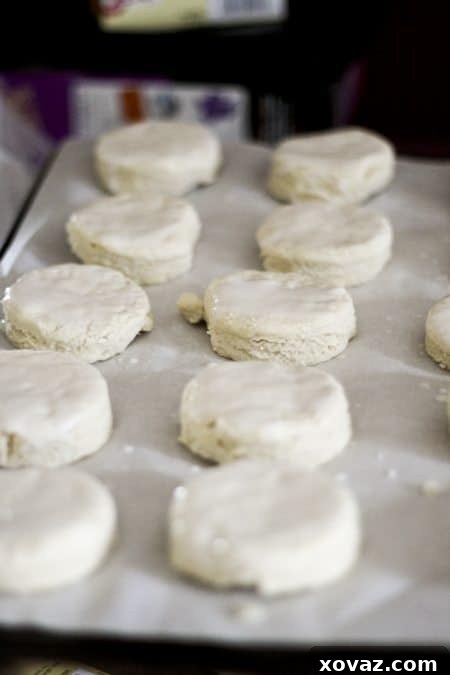
When transferring your cut biscuits to the baking pan, ensure you **do not crowd them**. Each biscuit needs ample space to expand and develop those beautiful, craggy, layered sides. Overcrowding will stifle their rise and result in biscuits that merge into a single, less-than-flaky mass. With so many do’s and don’ts in this recipe, I’m pleased to offer an optional, purely aesthetic step for baking.
If you desire a lovely, glossy brown top on your biscuits, simply brush them with a little extra buttermilk before baking – a step I always follow. If you prefer a more rustic, flour-dusted appearance, you can skip this step entirely. It’s solely a matter of personal preference, and won’t impact the incredible texture of your Perfect Flaky Layered Buttermilk Biscuits.
Freeze for Future Feasts: Enjoy Biscuits Anytime
One of the fantastic aspects of this recipe is that it yields a generous batch of Perfect Flaky Layered Buttermilk Biscuits. It truly does! More than even our “Viking horde” of a family can typically consume in a single sitting (though I admit, we’ve certainly tried!). When I’m feeling particularly organized, I often freeze half of the unbaked dough for future meals. And on truly productive days, I’ll whip up an entire batch of dough, cut out all the biscuits, and freeze every single one.
You might be wondering if frozen biscuits bake up as beautifully as fresh ones. It’s a valid question, and one I’m happy to address with proof.
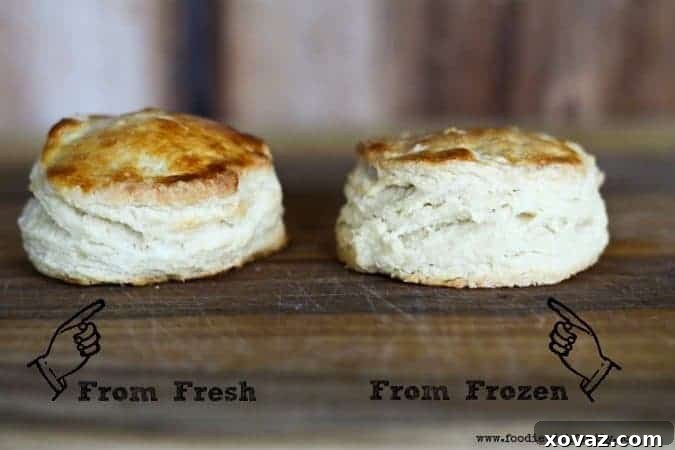
Feast your eyes on the evidence: the Homemade Buttermilk Biscuit on the left was baked from freshly prepared dough. The biscuit on the right was cut and then frozen for a week before being baked. Both are incredibly fantastic – moist, wonderfully flaky, and layered from top to bottom with all the glorious goodness you expect from a perfect biscuit. In my experience, there’s even a delightful bonus: the frozen biscuits tend to puff up just a little higher than their fresh counterparts!
Having a stash of frozen, unbaked biscuits in the freezer is a true game-changer. They’re perfect for busy weeknight dinners, impromptu brunches, or unexpected dinner guests. The convenience of fresh-baked goodness with minimal effort is simply unbeatable. So, now that you know all the secrets, who’s ready for a Homemade Buttermilk Biscuit?
Classic Buttermilk Biscuits Recipe
Lofty, flaky, layered-from-top-to-bottom, golden brown, moist, and delicious homemade Buttermilk Biscuits, perfect for slathering with cold butter and strawberry jam or sopping up savory sausage gravy. Bonus: You can freeze the dough and bake them fresh later!
Yields: 24 biscuits (using a 2-inch cutter)
Prep Time: 20 mins
Cook Time: 10 mins
Total Time: 30 mins
Ingredients
- 4 cups self-rising flour (approx. 1 pound by weight)
- 1/2 cup very cold butter (1 stick or 4 ounces by weight)
- 1 1/3 cups real cultured buttermilk, plus extra for brushing (if desired)
- All-purpose flour for dusting the work surface
Instructions
- Preheat your oven to 425°F (220°C). Add the self-rising flour to a large mixing bowl.
- Cut the stick of very cold butter in half. For one half, cut it lengthwise into 4 batons, then crosswise into small cubes. For the other half, slice it into pats as thinly as possible. Add both the cubes and pats of butter to the flour.
- Using only your fingertips, gently toss the butter into the flour until each piece is fully coated. Then, one piece at a time, quickly rub each pat and cube of butter between your fingers, as if rubbing dried glue off. Continue until all the butter has been rubbed into uneven pieces no larger than small peas. Avoid using the palms of your hands to prevent melting the butter.
- Pour all but about 2 tablespoons of the buttermilk around the inside edges of the bowl. Reserve the remaining buttermilk. Use a sturdy spoon, silicone spatula, or flexible dough scraper to toss the buttermilk into the butter and flour mixture until a shaggy dough begins to form. If the mixture is still very dry, toss in the reserved buttermilk. To check consistency, pick up a small amount of dough and squeeze it; if it holds together, you’re ready. If most of the mixture is still quite dry, add buttermilk 1 tablespoon at a time until it just holds together when squeezed.
- Lightly dust a clean work surface with all-purpose flour (not self-rising flour). Scrape the dough out into a pile. Quickly and gently use just enough pressure to pat the pile of dough into a rectangle about 2 inches thick. As you pat, gently incorporate any crumbling edges back into the main dough mass.
- Slide both hands under one side of the dough (at about 9 o’clock if visualizing a clock face), lift it up, and fold it over to the other side at 3 o’clock, like closing a book. Pat the dough back out into a 2-inch thick rectangle. Next, slide your hands under the bottom of the dough (6 o’clock) and fold it up towards 12 o’clock. Repeat the patting into a 2-inch rectangle, folding from 9 to 3 o’clock, patting, then folding from 6 to 12 o’clock. With each repetition, the dough should become a little more cohesive.
- Lightly flour a rolling pin. Very gently roll out the dough to your desired shape, aiming for a thickness of 3/4-inch to 1-inch. Flour a sharp, round or square, open-topped biscuit or cookie cutter. Cut straight down into the biscuit dough, without twisting or spinning the cutter. Cut the biscuits as closely together as possible to minimize scraps. If using a knife, cut straight down to form squares.
To Bake Right Away:
- Transfer the cut biscuits to a greased or parchment-lined baking sheet, ensuring at least 2 inches of space between each biscuit. Brush the tops with additional buttermilk if a glossy, golden finish is desired.
- Place the baking sheet in the preheated 425°F (220°C) oven. Bake for 8-12 minutes, rotating the pan front to back halfway through baking, until the biscuits are golden brown, look delicious, and are beautifully lofty.
- Remove from the oven and let stand for at least 2 minutes before serving or transferring to a towel-lined bowl.
To Freeze Biscuits for Later:
- Transfer the unbaked, cut biscuits to a parchment-lined baking sheet. Cover lightly with plastic wrap and place the baking sheet in the freezer until the biscuits are frozen solid.
- Once frozen, stack them in a resealable freezer bag, label with the date, and store frozen for up to 3 months. Biscuits stored longer may still be bake-able but might not rise as high or be quite as tasty.
To Bake Frozen Biscuits:
- Preheat your oven to 475°F (245°C). Line a baking sheet with parchment paper. Arrange the frozen biscuits on the sheet, leaving at least 2 inches between each.
- Brush the tops of the biscuits with buttermilk. Bake for 5 minutes at 475°F (245°C).
- After 5 minutes, reduce the oven temperature to 425°F (220°C) and continue baking for another 10 minutes, or until the biscuits are golden brown, beautifully lofty, and thoroughly cooked.
- Remove from the oven and let stand for at least 2 minutes before enjoying or transferring to a towel-lined bowl.
Cook’s Notes
- While yields can vary slightly, using a 2-inch round cutter typically produces about 24 Homemade Buttermilk Biscuits from this recipe.
- For less work and minimal waste, feel free to cut your biscuits into squares instead of rounds.
- For this recipe, it is highly recommended to use real cultured buttermilk. While the old trick of mixing vinegar with milk can work as a substitute in some recipes, this is one instance where true buttermilk makes a significant difference in flavor and texture.
Recommended Tools for Baking Buttermilk Biscuits
- Round Biscuit Cutters
- Silicone Baking Mat
- Dough Scraper / Bench Scraper
- Large Mixing Bowl
- Sheet Pan
- Parchment Paper
Nutrition Information (Estimate Per Biscuit)
Calories: 117kcal | Carbohydrates: 15g | Protein: 2g | Fat: 4g | Saturated Fat: 2g | Cholesterol: 11mg | Sodium: 48mg | Potassium: 38mg | Vitamin A: 140IU | Calcium: 20mg | Iron: 0.2mg
Nutritional information is an estimate and provided to you as a courtesy. You should calculate the nutritional information with the actual ingredients used in your recipe using your preferred nutrition calculator.

Connect with Foodie with Family
facebook | pinterest | instagram | twitter
Looking for more delicious options to fill your freezer and pair with your Buttermilk Biscuits? Try these fantastic recipes!
Turkey Breakfast Sausage comes together in a flash and is easily stored in the freezer using a clever method that lets you pull single patties from the bulk package for quick, healthy meals any day of the week.
Alternatively, ladle copious amounts of this terrific Classic Sausage Gravy over your Perfect Flaky Layered Buttermilk Biscuits, and you’ll undoubtedly be one very happy human indeed! It’s the ultimate comfort food pairing.

This post was originally published on October 26th, 2013, with updated notes in November 2015, July 2017, and March 2021.