
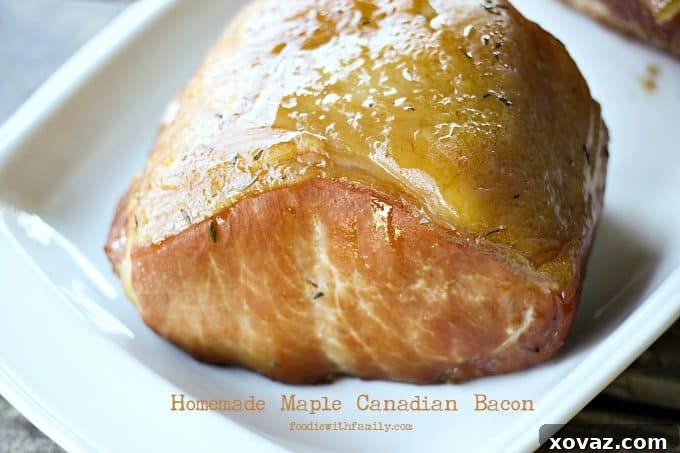
There’s a certain magic that happens when you take familiar ingredients and transform them into something extraordinary right in your own kitchen. This holds especially true for charcuterie, and if you’re a fan of rich, savory flavors, you’re in for a treat. Forget everything you thought you knew about store-bought Canadian bacon; this homemade version, crafted from perfectly cured pork loin infused with subtle maple and fragrant sage, is a revelation. It transcends any commercial counterpart I’ve ever tasted, delivering an unparalleled depth of flavor and tender texture.
Our household has always held a deep appreciation for meat, with pork, in particular, being a consistent favorite. Within the vast world of pork, bacon of all varieties brings immense joy to my family. A few weeks ago, after I successfully ventured into making homemade streaky bacon, one of my children, happily munching a crispy strip, mused aloud, “I wonder if Mom could make Canadian bacon, eh?” A quick clarification followed: “That was a Canadian ‘eh,’ not a Michigan one!” accompanied by a burst of infectious giggles. It’s delightful to witness their budding regional accent awareness, but more importantly, their innocent query sparked a creative challenge in me.

Though not a direct command, that casual question ignited a culinary quest. If I could master classic American bacon, why couldn’t I conquer its leaner, more refined cousin from north of the border? The notion of crafting Canadian bacon from scratch became an irresistible project, promising delicious rewards and the satisfaction of culinary self-sufficiency. The beauty of Canadian bacon lies in its versatility and nutritional profile. Being exceptionally lean, it requires only a quick warm-through rather than extensive frying, making it an incredibly convenient and healthier option for a fast breakfast or brunch. It’s a fantastic alternative to traditional streaky bacon, offering a distinct flavor and texture that many prefer.
Interestingly, what we commonly call “Canadian bacon” in the United States isn’t actually the traditional bacon of Canada. Canadians typically enjoy “peameal bacon,” which is a lean, unsmoked pork loin rolled in ground cornmeal. Our “Canadian bacon” is closer to what Europeans might call back bacon or simply cured loin. This distinction, while interesting, doesn’t diminish its deliciousness or the surprising ease with which it can be made at home. Preparing this gourmet breakfast staple is far simpler than you might imagine, belying the incredibly complex and satisfying flavors of the end product. The result is a cured pork loin, subtly infused with the sweetness of maple and the earthy notes of sage, which truly surpasses any store-bought variety I’ve ever encountered. My discerning panel of taste-testers—my husband and sons—unanimously agreed. In fact, this homemade Canadian bacon has earned a coveted spot on not one, but three upcoming birthday meal requests, cementing its status as a family favorite.
Understanding Canadian Bacon: A Lean & Flavorful Choice
To embark on the journey of making perfect Canadian bacon, you must start with the right foundation: a quality boneless pork loin. It’s crucial to distinguish this from pork tenderloins; we’re seeking a center-cut, lean pork loin. These are widely available in most grocery stores, often sold in vacuum-sealed packages. While this recipe is tailored for approximately four pounds of loin, the brine can be easily scaled up if you procure a larger cut. Look for a loin that is firm, light pink, and has a consistent shape. The quality of your primary ingredient will significantly impact the final flavor and texture of your Canadian bacon.
One of the defining characteristics of this particular recipe is its distinct Canadian influence, which I proudly infuse with a generous pour of Grade B dark maple syrup into the brine. This isn’t just for sweetness; the dark syrup provides a rich, deep maple flavor that truly elevates the bacon. If Grade B is unavailable, a good quality Grade A dark maple syrup will also work beautifully, but remember, the darker the syrup, the more pronounced the maple notes will be. Should genuine maple syrup be completely out of reach, you can substitute it with a high-quality brown sugar pancake syrup for a delicious, albeit slightly different, outcome. The goal is to introduce that signature sweet depth that complements the savory pork so well.
Beyond the maple, fresh sage is an absolute must. While dried herbs have their place, the vibrant, aromatic essence of fresh sage is irreplaceable here. Purchase a fresh bundle from your local market, or if you’re lucky enough to have a neighbor with an herb garden, a polite request for a handful will yield fantastic results. Its peppery, slightly piney notes are fundamental to the flavor profile. On the heels of my strong recommendation for fresh sage, I’ll tell you that dried whole leaf thyme is perfectly acceptable. While fresh thyme is always lovely, it’s not as critical to the final product’s character as the fresh sage, offering a subtle complement rather than a dominant note.
Before introducing your pork loin to the flavorful brine, a little preparation is in order. Trim off as much excess fat as you can. While you don’t need to be surgically precise at this stage—any remaining fat will be even easier to remove after the bacon has been smoked or oven-cooked—removing the bulk of it now helps the cure penetrate more effectively and results in a leaner finished product. Don’t discard this trimmed fat! Once cured and cooked, it can be rendered down and used to add incredible depth to dishes like beans or greens, embodying a nose-to-tail philosophy of cooking.
For optimal curing, I recommend cutting the pork loin into manageable pieces that fit comfortably within gallon-sized resealable freezer bags. This ensures the meat remains fully submerged in the brine, allowing for an even and thorough cure. Submersion is key to consistent flavor and proper preservation, ensuring every inch of that pork loin transforms into succulent Canadian bacon.
The Magic of Curing: Achieving Perfection
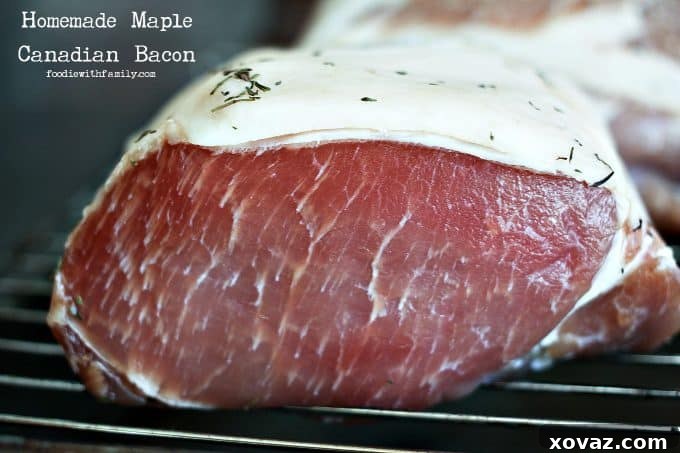
The transformation of a simple pork loin into delectable Canadian bacon hinges on the curing process. This isn’t just about adding flavor; it’s a centuries-old technique that preserves meat, enhances its texture, and creates unique flavor compounds. The brining period, a patient 72 hours, allows the salt, sugar, maple syrup, and aromatic herbs to permeate the pork, tenderizing it and building the complex taste profile that defines this dish. Following the brine, an essential 24-hour air-drying phase in the refrigerator helps develop a pellicle—a slightly sticky surface—which is crucial for smoke adherence and achieving that beautiful, glossy finish during cooking. Do not skip this drying step, as it contributes significantly to both flavor and texture.
When it comes to cooking your cured Canadian bacon, you have two excellent options: smoking or roasting. Smoking over applewood chips imparts an absolutely fabulous, nuanced flavor that is generally preferred for its depth and authenticity. If you have access to a smoker, this method will yield the most professional and flavorful results. However, if a smoker isn’t part of your kitchen arsenal, a conventional oven set to a very low temperature can still produce outstanding Canadian bacon. For those who crave that smoky essence without a dedicated smoker, a small smoke box placed in the oven can work wonders. Regardless of your chosen method, the objective is to cook the pork loin gently until its internal temperature reaches 150°F (65°C), ensuring it’s fully cooked yet remains tender and juicy. Detailed instructions for both smoking and roasting are provided in the recipe below, making this gourmet endeavor accessible to every home cook.
Once cooked and cooled, your homemade Canadian bacon will store remarkably well. Thanks to the pink salt used in the curing process, it can last for up to 10 days in the refrigerator when tightly wrapped. For longer preservation, tightly wrap the bacon in a double layer of plastic wrap, followed by a layer of aluminum foil, and stash it in the freezer where it will keep perfectly for up to six months. This extended shelf life makes it ideal for batch cooking, allowing you to enjoy gourmet breakfast meat whenever the craving strikes.
The Importance of Pink Curing Salt (Prague Powder #1)
A critical ingredient in this recipe is pink curing salt, specifically Prague Powder #1. I chose to include it, adapting principles from Michael Ruhlman’s authoritative work, “Charcuterie,” which makes a compelling argument for its use in cured meats. It’s imperative to understand that this is **not** the same as Himalayan pink salt, which is merely a rock salt and does not contain the necessary curing agents. Prague Powder #1 is a blend of sodium chloride (table salt) and sodium nitrite, often dyed pink to prevent accidental misuse or confusion with regular salt. Its role in curing is multifaceted and vital for both flavor and safety.
Pink curing salt serves several crucial functions:
- Food Safety: It is highly effective in preventing the growth of harmful bacteria, most notably Clostridium botulinum, which causes botulism. This is especially important for meats undergoing a long curing process at refrigerator temperatures.
- Preservation: It significantly extends the shelf life of the meat by inhibiting bacterial spoilage.
- Flavor: It contributes to the distinctive “cured” flavor profile we associate with bacon and other preserved meats.
- Color: It helps maintain the appealing pink color of the cooked meat. Without it, your Canadian bacon would cook to a brownish-grey color, much like a roasted pork loin, rather than the characteristic pink hue.
If you opt to omit pink curing salt, be aware that your Canadian bacon will have a significantly shorter refrigerated shelf life and will possess a more brownish color after cooking. More importantly, omitting it increases the risk of bacterial growth, particularly if the meat is not handled or cooked immediately and thoroughly. For safety reasons, especially when making cured meats at home, I strongly recommend using Prague Powder #1 as directed. Always source it from a reputable supplier and handle it with care, as it is a potent ingredient that must be used precisely according to recipe specifications. A little goes a long way, and adhering to the recommended amounts is crucial for both safety and optimal results.
Making Canadian bacon at home is a rewarding culinary adventure that promises superior flavor and a deep sense of accomplishment. With careful attention to detail and the right ingredients, you can elevate your breakfast experience to new heights and impress your family and friends with this gourmet delight.
Homemade Maple Canadian Bacon {Smoker Optional}
Author: Rebecca Lindamood
Prep Time: 15 mins
Cook Time: 2 hrs 10 mins
Total Time: 2 hrs 25 mins
This cured pork loin with mild maple and sage flavors eclipses any commercially available Canadian bacon I’ve ever had in my entire life. Barely adapted from and with thanks to Michael Ruhlman’s Charcuterie.
Ingredients
- 1 gallon water (4 liters)
- 1 1/2 cups Morton’s kosher salt (350 grams)
- 1 cup raw sugar (250 grams)
- 8 teaspoons pink salt (Prague Powder #1) (42 grams)
- 1 cup Grade B Dark Maple Syrup (236 ml)
- 1 bunch fresh sage
- 1 tablespoon dried thyme
- 2 garlic cloves (peeled and smacked with the side of a knife to lightly crush)
- 4 pounds boneless pork loin (excess fat removed)
Instructions
- Combine the water, salt, sugar, pink salt, maple syrup, sage, thyme, and garlic cloves in a stockpot. Bring to a simmer and stir to dissolve the sugar and salt. Remove from the heat and refrigerate until chilled all the way through. Trim the pork loin down to fit into two or more gallon sized resealable freezer bags. Insert the pork loin in the bags, then pour the cooled brine into the bags to cover the loins. Squeeze as much air as possible from the bags, then place the filled bags in a high-sided roasting pan and place the pan in the refrigerator for 72 hours.
- After 72 hours, drain the brine, rinse the pork loins, and place on a rack over a baking sheet. Put that back into the refrigerator for 24 hours to air dry.
To Smoke the Canadian Bacon:
- Hot smoke at 200°F (93°C) over applewood chips for 2 to 3 hours, according to your smoker manufacturer’s instructions, or until the internal temperature of the pork loin reaches 150°F (65°C).
To Roast the Canadian Bacon:
- Preheat your oven to 200°F (93°C). Take the air-dried pork loin and put it in the oven still on its rack over its pan, and cook until the internal temperature reaches 150°F (65°C).
- Trim any remaining excess fat, then allow to cool to room temperature. Wrap the pork tightly and refrigerate for up to 10 days or wrap in a double layer of plastic wrap then a layer of foil and freeze for up to 6 months.
Nutrition
Calories: 127 kcal | Carbohydrates: 13g | Protein: 12g | Fat: 2g | Cholesterol: 35mg | Sodium: 5921mg | Potassium: 236mg | Sugar: 12g | Vitamin A: 5IU | Vitamin C: 0.1mg | Calcium: 24mg | Iron: 0.5mg
Nutritional information is an estimate and provided to you as a courtesy. You should calculate the nutritional information with the actual ingredients used in your recipe using your preferred nutrition calculator.
Did you make this recipe?
Make sure to tag @foodiewithfam on Instagram and #hashtag it #foodiewithfamily so I can check it out!
Need a little help finding some Pink Curing Salts for your meat projects? Here’s a handy Amazon affiliate link to some Prime eligible Pink Curing Salt!