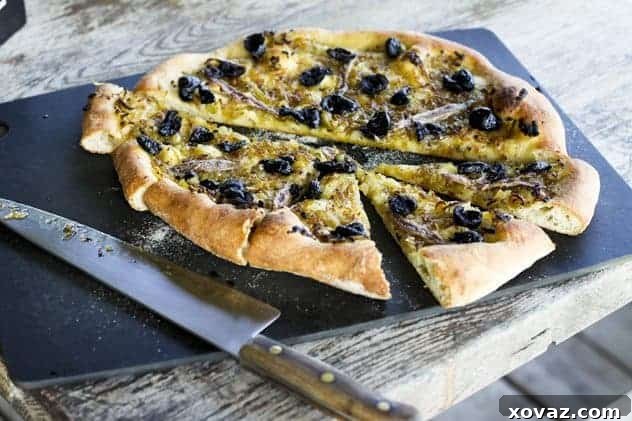
Pissaladière: A Culinary Journey into French Savory Flatbread
In the vibrant tapestry of French cuisine, few dishes capture the essence of Provençal charm and simplicity quite like Pissaladière. Often described as France’s answer to pizza, this traditional savory tart from Nice transcends the ordinary, offering a sophisticated medley of flavors that delights whether served warm or at room temperature. It’s the quintessential French street food, a true testament to the region’s culinary heritage, and an absolute delight for picnics, appetizers, or a light meal. Imagine a crisp, golden crust generously topped with a scandalously thick layer of deeply caramelized onions, artfully adorned with salty anchovies and briny Niçoise olives. This isn’t just a dish; it’s an experience – a slice of the good life, perfectly paired with a chilled glass of crisp white wine.
The Heart of Provence: Unpacking Pissaladière’s Allure
While the concept of a flatbread topped with savory ingredients might evoke images of Italian pizza, Pissaladière stands proudly distinct. Its character is defined by a slightly breadier crust than its Italian cousin, providing a satisfying chew that complements the rich toppings. The true star, however, is the onion confit – a slow-cooked revelation that transforms humble onions into a sweet, velvety puree. This luscious base, combined with the intense umami of anchovies and the distinct saltiness of Niçoise olives, creates a harmonious flavor profile that is both rustic and refined. For those who appreciate the bold, authentic tastes of the Mediterranean, Pissaladière is an irresistible invitation to explore the depth of French culinary tradition.
Mastering the Pronunciation: PEE-sah-lah-dee-air
Before diving into its rich history and flavors, let’s demystify the name. Pissaladière is pronounced PEE-sah-lah-dee-air. A gentle elongation of the “aaaaiiiiirrr” sound will lend it a touch of French authenticity, but fear not if your accent isn’t perfect; locals will undoubtedly understand your request for this beloved dish. French culture, deeply intertwined with the appreciation of good food, embraces anyone who shares their passion for delicious fare.
Tracing the Roots: The History of Pissaladière
While undeniably a classic French dish today, Pissaladière’s origins are deeply intertwined with the historical fluidity of the Mediterranean region. Its roots can be traced back to the Ligurian region of Italy, particularly the area surrounding Nice. In 1860, when the County of Nice was annexed to France, it brought with it not just a new territory but also a rich tapestry of culinary traditions, including this iconic flatbread. This fascinating cross-cultural journey underscores the shared gastronomic heritage of the Franco-Italian Riviera.
The name “Pissaladière” itself offers a glimpse into its ancient past, deriving from the Latin word piscis, meaning “fish.” Over time, this evolved into pissalat, which refers to a traditional anchovy paste – a highly prized, old-school condiment made from the fry of sardines and anchovies. Historically, this intensely flavored paste was the foundational layer of the dish. However, due to strict regulations on fishing for young fish, pissalat has become increasingly rare and challenging to source. Fortunately, culinary committees, including those in France safeguarding traditional Nice cuisine (Cuisine Nissarde), recognize that using high-quality anchovy fillets is an acceptable and authentic alternative, preserving the spirit and taste of the original dish for modern palates.
Anchovies: The Umami Secret of Pissaladière
For many, anchovies are a polarizing ingredient. Yet, for those who truly understand their culinary power, they are nothing short of essential. These small, saltwater forage fish, rich in beneficial oils, are typically preserved by a meticulous process of gutting, brining, aging, and packing in salt or oil. This method concentrates their natural flavors, developing that distinctive, robust brininess and umami depth that anchovy enthusiasts adore.
Beyond the Fillet: Types and Uses of Anchovies
When shopping, you’ll most commonly encounter anchovy fillets packed flat in small tins of olive oil. Occasionally, you might find them elegantly wrapped around capers, also preserved in oil. For a truly special treat, look out for *boquerones en vinagre*, a Spanish preparation where anchovies are pickled in vinegar. These delicate, pale white anchovies offer a much milder flavor profile and a softer texture, often surprising those who believe they dislike anchovies entirely. They are a true testament to the versatility and diverse culinary applications of this humble fish.
It might surprise you to learn just how pervasive anchovies (or their concentrated essence) are in everyday cuisine. They are a secret ingredient in a surprising number of foods you might regularly enjoy, including classic Caesar salad dressing, Worcestershire sauce, many Asian fish sauces, and certain pasta sauces. Their role is often not to impart a direct “fishy” taste but to contribute a profound depth of savory flavor – an undetectable yet indispensable umami boost that elevates a dish from good to extraordinary. So, even if you think you’re not an anchovy fan, chances are you’ve appreciated their subtle influence without even realizing it.
The Health Benefits of Anchovies
Beyond their flavor-enhancing capabilities, anchovies are also remarkably nutritious. Much like their sardine cousins, they are an excellent source of easily digestible protein, essential calcium, iron, and selenium. They are also packed with vital vitamins, including D, B3 (Niacin), B6, and B12. Furthermore, as an oily fish, anchovies are rich in omega-3 fatty acids, which are crucial for heart health and brain function. If the texture of whole anchovies is a deterrent, a simple trick is to mash them thoroughly with a fork and cook them into sauces. They “melt” seamlessly into the dish, lending their complex flavor without any discernible texture.
Niçoise Olives: The Briny Jewels of the Riviera
The other traditional component of an authentic Pissaladière is the revered Niçoise olive. These small, intensely savory, brine-cured olives are a darling of French cuisine, cultivated along the sun-drenched French Riviera. Often preserved or marinated with local herbs, their distinct flavor makes them a wonderful base for tapenade or a delightful addition to dishes like Garlic Roasted Olives. Their robust, slightly bitter, and salty notes perfectly balance the sweetness of the caramelized onions and the richness of the anchovies.
When preparing Pissaladière, the decision to pit the olives is often a matter of cultural preference. In France, it’s common to serve olives with their pits, and diners are accustomed to exercising caution. However, in many other parts of the world, especially in the US, pitted olives are the norm. If you opt for un-pitted olives, it’s wise to forewarn anyone about to enjoy your Pissaladière to prevent any unwelcome surprises. If Niçoise olives are unavailable in your area, Kalamata olives make an excellent substitute, offering a similar taste profile and texture that will complement the dish beautifully.
Pissaladière vs. Traditional Anchovy Pizza: A Clear Distinction
While Pissaladière is often colloquially referred to as “French pizza,” it’s important to understand the distinctions that make it a unique and classic Provençal specialty, rather than just an anchovy-topped Italian pizza. A classic Italian anchovy pizza typically features a crust topped with a vibrant red tomato sauce, melted cheese, and anchovy fillets. Pissaladière, however, eschews both tomato sauce and cheese in its traditional form. Its “sauce” is the aforementioned slowly caramelized onions, cooked down until they achieve a silken, almost purée-like consistency. These velvety, fragrant onions are generously piled onto the crust, creating a sweet, savory foundation for the anchovies and olives.
Both dishes are undeniably delicious, each with its own charm. But Pissaladière, with its emphasis on the luxurious onion confit and the absence of cheese and tomato, offers a more distinctive and perhaps more refined culinary experience. It speaks to a different philosophy of flatbread, one that highlights the pure, concentrated flavors of its core ingredients, embodying the elegant simplicity of Provençal cooking.
Crafting Your Own Pissaladière: A Step-by-Step Recipe
Embark on your own culinary journey by preparing this delightful French flatbread. The process, while requiring a bit of patience for the onions, is ultimately rewarding, yielding a dish that will transport your taste buds straight to the south of France.
Pissaladière (French Pizza) Recipe
This recipe yields approximately 8 servings.
Ingredients
- 1 pound pizza dough
- 3 pounds onions, peeled, halved, thinly sliced into half-moons, then roughly chopped
- 1/4 cup olive oil
- 1/4 teaspoon dried thyme (or 1/2 teaspoon fresh thyme)
- 1 bay leaf
- 3 garlic cloves, peeled and thinly sliced
- 1/2 teaspoon kosher salt
- Black pepper to taste
- 8-10 oil-packed flat anchovy fillets, patted dry (or more, to taste)
- 16 Niçoise olives, pitted and halved (or more, to taste)
Optional but Tasty:
- 1 roasted red bell pepper, stem and seeds removed, thinly sliced into strips
Instructions
- Preheat your oven and a pizza stone to 500°F (or up to 550°F if your oven allows for higher temperatures).
- While the oven preheats, gently heat the olive oil in a large, heavy-bottomed skillet over medium-low to low heat. Add the chopped onions, thyme, bay leaf, sliced garlic, salt, and pepper. Stir well to ensure the onions are evenly coated with oil. Cook gently for about 20 minutes, stirring occasionally, until the onions are thoroughly softened and just beginning to lightly brown around the edges. It is crucial not to fully caramelize them at this stage, as they will continue to cook in the oven and could scorch, imparting a bitter, burned taste to your Pissaladière. Remove the bay leaf before proceeding.
- Generously dust your work surface with flour. Gently stretch your pizza dough into a circular or rectangular shape. Use a floured rolling pin to achieve a uniform thickness of approximately 1/8-inch. Prepare a pizza peel by covering it generously with semolina or cornmeal to prevent sticking. Carefully transfer the stretched dough to the prepared peel.
- Spread the onion mixture, including any accumulated oil, evenly over the dough, leaving a 1/4-inch border around the edges. Artfully arrange the anchovy fillets and olive halves over the top of the onions. If you are using the optional roasted red bell pepper strips, place them decoratively among the anchovies and olives. Give the pizza peel a gentle shake to ensure the dough isn’t sticking; if it is, carefully lift the area and sprinkle more semolina or cornmeal underneath.
- Carefully slide the assembled Pissaladière onto the preheated pizza stone in the oven. Bake for 8 to 15 minutes, depending on the intensity of your oven’s heat, or until the crust is evenly browned and wonderfully crisp underneath. Use the pizza peel to transfer the finished Pissaladière to a cutting board.
- Allow the Pissaladière to cool for five minutes before cutting it into wedges. Serve warm or at room temperature.
Notes
If you find anchovies to be excessively salty for your taste, you can soak them in a small bowl of cool water for approximately 30 minutes before use. This process helps to draw out some of the excess salt. After soaking, be sure to pat them thoroughly dry with paper towels before adding them to your Pissaladière to ensure they adhere well and maintain their texture.
Nutrition Information (Estimate Per Serving)
Calories: 287kcal | Carbohydrates: 44g | Protein: 7g | Fat: 10g | Saturated Fat: 2g | Polyunsaturated Fat: 1g | Monounsaturated Fat: 6g | Cholesterol: 2mg | Sodium: 755mg | Potassium: 279mg | Fiber: 4g | Sugar: 11g | Vitamin A: 64IU | Vitamin C: 15mg | Calcium: 54mg | Iron: 2mg
Nutritional information provided is an estimate and offered as a courtesy. It is recommended to calculate the nutritional information using the actual ingredients in your recipe with your preferred nutrition calculator.
Serving Suggestions and Pairings
Pissaladière’s versatility is one of its greatest assets. It shines as an elegant appetizer at a dinner party, a satisfying centerpiece for a light lunch, or the star of a relaxed picnic spread. When serving, consider pairing it with a crisp, dry white wine, such as a local Provençal Rosé, a Vermentino, or a Sauvignon Blanc, which will complement its rich, savory flavors without overpowering them. For a complete Mediterranean experience, serve it alongside a simple green salad dressed with a light vinaigrette.
Embrace the Essence of Provençal Culinary Art
Pissaladière is more than just a dish; it’s an emblem of Provençal cuisine – simple ingredients transformed by patience and tradition into something truly extraordinary. Its harmonious blend of sweet caramelized onions, salty anchovies, and briny olives creates a flavor profile that is both comforting and sophisticated. Whether you’re a seasoned chef or an adventurous home cook, preparing Pissaladière is a delightful way to explore the rich culinary landscape of France and savor a piece of its gastronomic history. Give it a try, and discover why this “French pizza” has captivated hearts and palates for centuries.
Did you make this recipe?
Share your creations! Tag @foodiewithfam on Instagram and use the hashtag #foodiewithfamily so we can see your delicious Pissaladière!
This post was sponsored by Frigidaire.