The aroma of baking pizza is universally comforting, conjuring images of cozy nights and shared meals. Yet, achieving that perfect, gourmet pizza experience at home can often feel like a culinary quest, especially when time is a luxury. For those of us with discerning palates who believe a meal costing twenty dollars should be nothing short of perfection, store-bought options rarely measure up. This pursuit of the ultimate homemade pizza, even on the busiest evenings, led to a revelation: the power of frozen, partially baked pizza crusts. What started as an innovative approach for a demanding food blog challenge has become a cherished kitchen hack, transforming last-minute cravings into effortless culinary triumphs.
My passion for pizza is unwavering. I could genuinely enjoy a slice every single day. From the classic pepperoni and cheese to the tropical zest of Hawaiian, or the hearty depths of Chicago deep dish, I embrace it all. However, my love for pizza comes with a significant caveat: I am incredibly particular about it. Ordering takeout often results in disappointment; local pizzerias, bless their hearts, just don’t consistently hit the mark for my high standards. Good pizza demands planning and dedication, but spontaneous cravings still need to be satisfied. So, how does a self-proclaimed “pizza snob” whip up a quick, quality pizza when the urge strikes? The answer, delightfully simple, lies within the freezer.
The Secret Weapon: Frozen Partially Baked Pizza Crusts
Most home cooks understand the convenience of keeping frozen pizza dough on hand. But have you considered the next level of meal prep: frozen, partially baked pizza crusts? Forget the bland, shrink-wrapped shells from the grocery store. These homemade versions are a game-changer – they’re not just convenient, they’re genuinely delicious. They provide a sturdy, flavorful foundation that elevates your impromptu pizza nights from acceptable to exceptional.
The process itself holds no grand mysteries, but its impact on weeknight dinners is profound. On a day when you have a bit of extra time, prepare your favorite pizza dough. Portion it, roll it out, or stretch it into your desired pizza shape. Bake these crusts for just a few minutes, pulling them from the oven before they even begin to brown. Once cooled completely, these pre-cooked wonders are ready for the freezer. This simple act of foresight guarantees that a superior homemade pizza is always just minutes away, a far cry from waiting for delivery or settling for mediocre alternatives. Here are some essential tips to keep in mind when preparing your partially baked pizza crusts:
- Harness the Power of a Pizza Stone: For unparalleled results, always use a pizza stone that has been preheated with your oven. This ensures an even, high heat transfer, leading to a perfectly crisp crust. Transfer your dough onto and off the stone using a cornmeal-dusted peel. If a pizza stone isn’t part of your kitchen arsenal, a parchment-lined baking sheet generously dusted with cornmeal or semolina is the next best option. The goal is to mimic the intense, direct heat a professional pizza oven provides.
- Be Generous with Cornmeal or Semolina: A liberal dusting of cornmeal or semolina flour on your peel, pan, or parchment paper is non-negotiable. Since these crusts are only partially baked, they are more susceptible to sticking before or after their initial bake. This crucial layer acts as a barrier, providing a little insurance against dough adhesion and ensuring a smooth transition to and from the oven.
- Cool Crusts Completely Before Freezing: Patience is a virtue here. Allowing your crusts to cool entirely before packaging them for the freezer is a small step that yields significant benefits. This prevents condensation from forming and turning your crusts soggy, preserving their texture and ensuring a superior final baked pizza. Skipping this step can compromise the crispness you’ve worked hard to achieve.
- Optimize Freezer Space with Stacking: To maximize precious freezer real estate, stack your cooled crusts, separating each layer with a square of parchment paper. Once stacked, wrap them tightly in a double layer of plastic wrap or seal them in a large freezer bag. The parchment paper can even be used beneath the crusts during their final bake, providing an extra layer of non-stick protection. This thoughtful storage method ensures your crusts remain fresh and freezer-burn-free for up to three months.
From Freezer to Feast: Mastering Quick Pizza Assembly
When time is scarce and the call for pizza is undeniable, simply retrieve a crust from the freezer, add your desired toppings, and bake. It genuinely doesn’t get any simpler. You can have a piping hot, personalized pizza on your table quicker than any local delivery service could manage. While the process is straightforward, a couple of expert tricks will ensure your homemade frozen shells transform into the perfect pizza every time:
- Opt for Pre-Cooked or Mostly Cooked Toppings: Because your crust is already partially baked, its final cooking time in the oven will be considerably shorter. This means your toppings will have less time to cook through. To avoid raw or undercooked ingredients, use pre-cooked, chopped meats (like pepperoni, which is already fully cooked) and sautéed vegetables. This ensures all elements of your pizza reach their optimal state of doneness simultaneously.
- Resist the Urge to Overload: This golden rule applies to fresh dough as well, but it bears repeating, especially with partially baked crusts. As tempting as it may be to pile on half a pound of cheese and an abundance of toppings, restraint is key. An overloaded crust will struggle to cook evenly; your cheese might melt into a bubbling, blackened mess while the crust underneath remains soggy. Too many toppings compromise the integrity and crispness of your crust. Exercise discipline for a perfectly balanced pizza.
- Embrace the Olive Oil Brush: For a crust that boasts a deep golden-brown hue and a satisfying, crackling crispness, lightly brush the outer edge of your pizza crust with olive oil before adding your toppings. This simple step aids in achieving that desirable texture and visual appeal. Of course, if you prefer a paler, softer crust, this step can be omitted to suit your preference.
Beyond the Basics: Creative Expeditions with Pre-Baked Crusts
Now that you’re equipped with the knowledge of make-ahead crusts, let’s explore some of my favorite ways to unleash their full potential:
- Unleash Your Inner Culinary Artist: Don’t be afraid to experiment. I’ve discovered that many of my favorite sandwich combinations—Reubens, Smoked Turkey with Cheddar, and French Dip Sandwiches, to name a few—translate exceptionally well into pizza form. Think outside the traditional pizza box: consider breakfast pizzas with eggs and bacon, or even dessert pizzas with fruit and sweet drizzles. The partially baked crust acts as a blank canvas, inviting endless creative possibilities.
- Host a “Build-Your-Own-Pizza” Bar: I have yet to encounter a child, or even an adult, who doesn’t adore the concept of creating their own pizza. For your next movie night or family gathering, set up an enticing spread of bowls filled with various toppings and sauces. Give each person their own pre-baked crust, and watch the happy faces emerge. This is also a genius way to utilize those odds and ends lingering in your refrigerator. A little leftover cooked chicken and some hot sauce? Hello, Buffalo Chicken Pizza!
- The Miracle Last-Minute Bread: More than once, I’ve pulled a pizza shell from the freezer, topped it simply with cheese, and placed it (on its parchment square) directly onto the rack of a hot oven. In mere minutes, as the cheese melts and bubbles, you have an almost instant, crispy bread. This makes a superb accompaniment to hearty soups, serving as a more substantial alternative to crackers. Dunked into a steaming bowl of sausage and white bean soup or a humble tomato soup, this quick bread truly shines, adding an unexpected layer of flavor and texture to your meal.
Recipe Spotlight: Ham and Swiss with Caramelized Onion on Rye Pizza
To help kickstart your freezer-stocking endeavors, I’m delighted to share one of my all-time favorite pizza crust recipes: Onion Rye. When rolled thinly, this crust achieves a cracker-crisp texture and possesses the robustness to hold up beautifully to a wide array of toppings. It’s the quintessential choice for my beloved “turn this sandwich into a pizza” game.
This distinctive rye crust serves as the perfect complement to the savory and tangy flavors of a classic deli Ham and Swiss on Rye sandwich. Tender, slow-cooked balsamic caramelized onions form the luscious sauce base for this pizza—a flavor profile so exquisite, you’ll be eager to bake another slice the moment you savor your first bite. And with a ready supply of these magnificent crusts waiting patiently in your freezer, what’s stopping you from indulging?
For a printer-friendly version of this recipe with no photos, click here!
Ham and Swiss with Caramelized Onion on Rye Pizza
Ingredients for Onion Rye Pizza Shells:
Yield: 4 individual-sized crusts, 2 small crusts, or 1 medium-large crust (Note: Yield has been adjusted to reflect the quantities specified in this recipe. As a habit, I often double my recipes—even my own—and my original yield was based on a doubled batch. My apologies for any previous confusion!)
- 1-1/4 cups water
- 1 Tablespoon canola oil
- 1 large egg yolk
- 2-1/4 cups bread flour
- 2 cups white whole wheat flour
- 1/4 cup rye flour (Use light, medium, or coarse, depending on your preferred rye intensity. I opt for coarse for a more pronounced flavor.)
- 1 Tablespoon malt powder or sugar
- 1 teaspoon salt
- Pinch of white pepper
- 2 Tablespoons dried onion flakes
- 2-1/2 teaspoons instant yeast
- Optional: 1 egg white whisked with 1 teaspoon water until frothy; caraway seeds and coarse salt for sprinkling over the edge of the crust.
Bread Machine Instructions:
Combine the water, canola oil, egg yolk, bread flour, white whole wheat flour, rye flour, malt powder (or sugar), salt, white pepper, dried onion flakes, and instant yeast in the pan of your bread machine. Follow your manufacturer’s instructions for ingredient order. Program for a standard dough cycle and press start.
Stand Mixer Instructions:
In the bowl of a stand mixer fitted with a dough hook, combine the water, canola oil, egg yolk, bread flour, white whole wheat flour, rye flour, malt powder (or sugar), salt, white pepper, dried onion flakes, and instant yeast. Turn the mixer to the lowest setting and mix continuously until a smooth and elastic dough forms, typically 8-10 minutes. Transfer the dough to a lightly greased bowl, cover it with a damp tea towel, and allow it to rise in a warm, draft-free environment until it has doubled in bulk, approximately 1 hour.
Hand-prepared Dough Instructions:
In a large mixing bowl, whisk together the bread flour, white whole wheat flour, rye flour, malt powder (or sugar), salt, white pepper, dried onion flakes, and instant yeast. Add the water, canola oil, and egg yolk, mixing with a sturdy spoon until a cohesive dough forms. Turn the dough out onto a lightly floured counter and knead for about 15 minutes, until it becomes smooth and elastic. Place the dough in a lightly greased bowl, cover with a damp tea towel, and let it rise in a warm, draft-free place until doubled in bulk, about 1 hour.
To Prepare the Pizza Crusts:
Preheat your oven to 425°F (220°C). If you have a pizza stone, place it in the oven during preheating.
Gently turn the risen dough out onto a lightly floured counter. Punch it down to deflate the air, then divide it into 4 equal pieces. A bench knife proves to be the most efficient tool for this task. Form each piece of dough into a smooth ball.
Carefully flatten the dough balls and cover them with a tea towel to prevent drying. Take one dough ball from beneath the towel and use a rolling pin or your hands to stretch it into an approximately 10-inch circular crust. Using a rolling pin is recommended for achieving the super-thin, cracker-crisp texture that truly enhances this particular recipe.
Generously dust a pizza peel (or a parchment-lined pan) with cornmeal or semolina flour. Carefully lift the dough circle and place it onto the dusted surface. If desired, brush the outer 1/2-inch edge of the crust with the whisked egg white mixture, then sprinkle with caraway seeds and coarse salt for an extra layer of flavor and texture. Using the peel, carefully slide the dough directly onto the preheated pizza stone (or place the pan into the oven). Bake for 4 minutes, or until small air bubbles begin to puff up on the dough’s surface. Remove the now partially-cooked crust from the oven and transfer it to a cooling rack. While the crust is still warm, gently pierce any significant air bubbles in the center (the part you will top) to ensure a flat, even surface for toppings. Repeat this process with the remaining dough balls.
Once all the partially baked crusts are completely cool, place each one on a square of parchment paper that matches its size. Stack the crusts with their parchment separators and wrap the entire stack tightly in a double layer of plastic wrap or place them in a large, resealable freezer bag. These crusts are best when used within 3 months of being made, ensuring peak freshness and flavor.
To Make a Ham and Swiss with Caramelized Onion Pizza (Serves Two):
- 2 frozen Onion Rye pizza crusts
- 4 large cooking onions, peeled, cut in half, and thinly sliced
- 2 Tablespoons unsalted butter
- A pinch each of salt and granulated sugar
- Balsamic vinegar (a splash or two, as needed)
- Freshly ground black pepper, to taste
- 12 thin slices of high-quality deli ham (honey baked ham is an excellent choice)
- 2-1/2 thin slices of Swiss cheese
- Optional: 2 teaspoons Dijon mustard mixed with mayonnaise for dipping
Begin by making the caramelized onions:
Melt the butter over very low heat in a heavy-bottomed, mid-sized saucepan. Add the thinly sliced onions to the pot, sprinkle them with the pinch of salt and sugar, and toss to ensure they are well coated with the butter. Continue to cook over low heat, stirring occasionally, until the onions begin to soften and release their natural juices. This slow cooking process is crucial for developing deep, rich flavor. Continue cooking for approximately 35 minutes, adding a small splash of balsamic vinegar whenever the onions appear to be drying out. The onions are perfectly caramelized when they are incredibly tender, almost seeming to melt, and possess a deep golden-brown color. They should be moist but not sitting in pools of liquid. Remove the pot from the heat and set aside.
Preheat your oven (and baking stone, if you are using one) to a blistering 500°F (260°C).
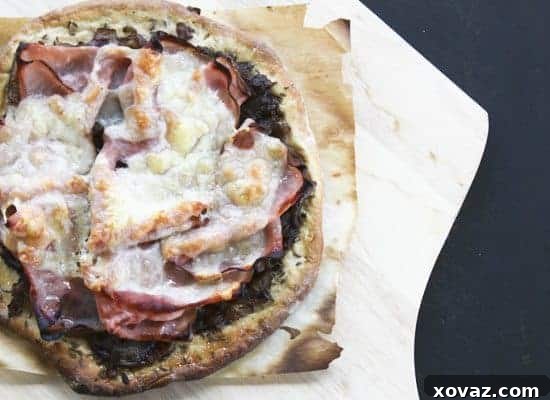
Retrieve two frozen Onion Rye Crusts (along with their parchment squares) from the freezer. Divide the prepared caramelized onions evenly between the two crusts, spreading them almost to the edges. Gently fold the ham slices and arrange them over the crusts, covering most of the onion base. Finally, distribute the Swiss cheese slices evenly over the ham. Using a pizza peel or your hands, carefully slide the parchment and crust onto the preheated pizza stone or directly onto the oven rack. Bake for 6-9 minutes, depending on your preference for crust crispness. A baking time of six minutes will yield a softer, lighter-colored crust, while nine minutes will produce a crisper, more deeply golden pizza, similar to the one depicted in the accompanying photographs.
Allow the pizzas to cool for 5 minutes before slicing and serving. If desired, serve with a side of Dijon mayonnaise for an extra tangy dipping sauce.
These make-ahead crusts have revolutionized my approach to homemade pizza, proving that convenience doesn’t have to come at the expense of quality. I encourage you to try these techniques and this delicious Ham and Swiss with Caramelized Onion on Rye Pizza. What are your favorite quick pizza hacks or unusual topping combinations? Share your thoughts and culinary adventures in the comments below!