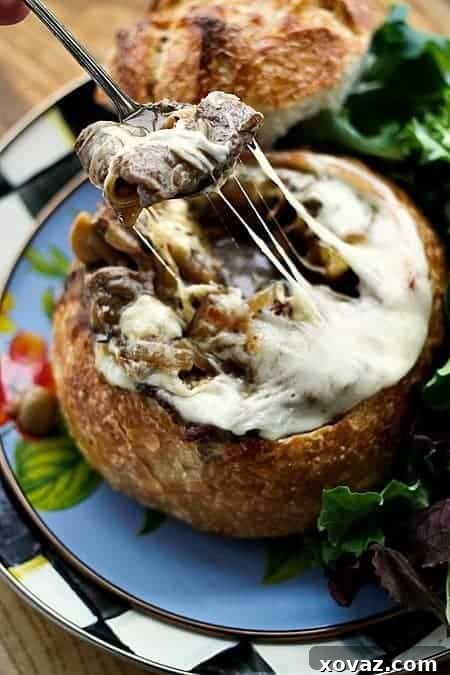

The Ultimate Comfort Food: Hearty Philly Cheesesteak Stew in Sourdough Bread Bowls
There’s something truly special about the bond of friendship, especially when it comes wrapped in the gift of a fantastic recipe. Not long ago, my dear friend Mary sparked an immediate culinary craving with a simple question: “Are you a fan of Philly cheesesteak sandwiches?” My enthusiastic, if slightly goofy, reply was: “I am a fan of *all* sandwiches!” She then revealed her discovery – a recipe for Philly Cheesesteak Stew, which she declared nothing short of fabulous. The idea instantly captivated me, painting a vivid picture of warmth and rich flavor.
My mind immediately began compiling a mental shopping list, eager to gather the necessary ingredients. However, fate, in the form of relentless heavy snow and an unwelcome household virus, conspired to delay my trip to the grocery store. The ingredients remained stubbornly on my list, a tantalizing promise of future deliciousness. Days turned into a week, and then two, as the snow continued to fall and the sniffles persisted. The thought of that comforting stew became my personal carrot, a beacon of delicious hope guiding me through the dreary weather and the general malaise.
Finally, as if by a culinary miracle, the skies cleared, and health returned to our home. Bundling up against the lingering chill, I embarked on the half-hour drive to the nearest well-stocked grocery store, my meticulously crafted list clutched firmly in hand. With all the essential ingredients procured, I hastened home, driven by an almost desperate eagerness to begin cooking. I would have started immediately, regardless of the hour; the anticipation had built to an unbearable level, and I simply couldn’t wait another moment to bring this stew to life.
Mercifully, this is a dish that comes together with surprising speed, a fact for which my growling stomach was immensely grateful. While the stew simmered, filling the kitchen with its utterly irresistible aroma, I found myself constantly battling the urge to raid every cupboard. The wait, though only two weeks in reality, felt like an eternity. Few things consume my thoughts quite like an eagerly anticipated meal, and this Philly Cheesesteak Stew had become a full-blown obsession. Each rising scent intensified my hunger, making the final assembly feel like a triumphant crossing of the finish line.
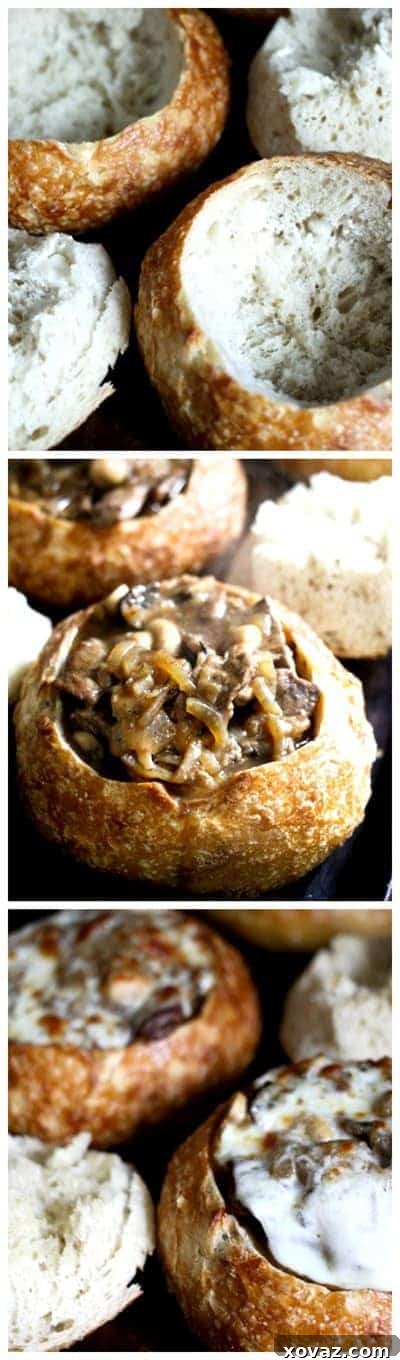
The moment arrived to ladle the rich, savory stew into its edible vessels: small, hollowed-out loaves of crusty sourdough bread. The silky, onion-infused beef gravy beckoned, and I literally had to swat my own hand away to prevent it from preemptively dunking bread scraps into the pot. With the bread bowls filled, I gracefully draped slices of provolone cheese over the top, carefully transferring the pan under the broiler. Standing by, spoon at the ready, I watched with bated breath as the cheese bubbled and transformed into a golden-brown, irresistible crust. The instant it reached perfection, I pulled the pan from the oven, using a large spatula to transfer one magnificent bread bowl, complete with its giant buttery crouton, to a plate. Resistance was futile.
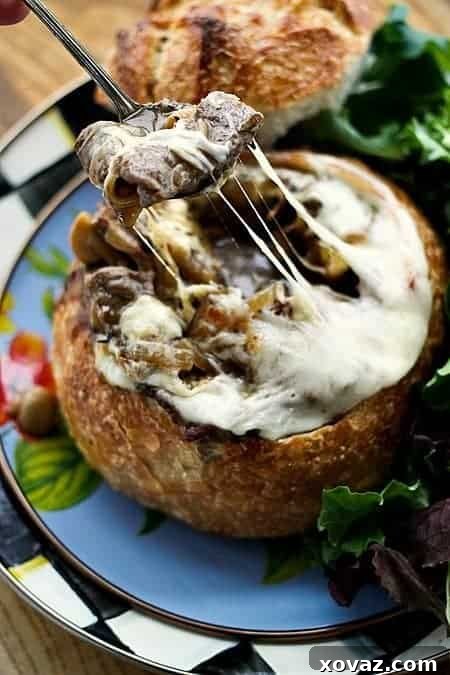
I simply had to dig in immediately. Could anyone truly blame me? This wasn’t just a meal; it was an experience. Imagine a robust beef gravy, teeming with perfectly seasoned beef browned to perfection in butter, complemented by deeply caramelized onions and earthy sautéed mushrooms. All of this glorious goodness nestled within a crusty sourdough bread bowl, crowned with melted provolone cheese, broiled until exquisitely bubbly, and served alongside a substantial, buttery crouton. If you claim you could have resisted such a masterpiece, I humbly suggest you possess a willpower far greater than mine!
Why This Philly Cheesesteak Stew Will Become Your New Favorite
This Philly Cheesesteak Stew transcends the ordinary, offering a heartwarming culinary journey that marries the beloved flavors of a classic sandwich with the soul-satisfying comfort of a homemade stew. It’s more than just a meal; it’s an indulgence, a bowlful of rich textures and deep flavors designed to soothe the senses and satisfy the deepest cravings. The tender, thinly sliced beef, the sweet, savory onions, and the earthy mushrooms are all enrobed in a luxuriously thick, flavorful gravy that speaks of culinary expertise and careful preparation. Serving it in a sourdough bread bowl adds an unparalleled element of rustic charm and practicality, ensuring every last drop of that delectable gravy is savored. The final touch of bubbly, melted provolone cheese transforms each serving into a miniature edible masterpiece, making it an ideal choice for a cozy family dinner or a delightful gathering with friends.
Expert Tips for Crafting the Perfect Philly Cheesesteak Stew
Achieving culinary perfection often lies in understanding the subtle nuances of technique. Here are some invaluable hints to elevate your Philly Cheesesteak Stew from delicious to utterly unforgettable:
-
Unlock Deep Flavor with the Right Pan
For truly exceptional browning of your beef and proper caramelization of your onions, a non-stick surface is not your friend. Opt for a regular stainless steel, cast-iron, or enameled pan. These materials facilitate the formation of ‘fond’ – those delicious, crusty, caramelized bits that cling to the bottom of the pan. Fond is pure flavor gold! When you caramelize the onions, these bits will naturally loosen. Later, when you add the flour, they might seem to stick again, but don’t fret; all that goodness will effortlessly release when you incorporate the beef broth, contributing an unbeatable depth of flavor that simply cannot be replicated with a non-stick pan.
-
Mastering Thin Beef Slices
The hallmark of a great cheesesteak, even in stew form, is thinly sliced beef. To make this task easier, consider partially freezing your beef top round. Break the beef down into manageable pieces, approximately 2 inches wide and half an inch deep, then place them on a plate in the freezer for about 15 minutes. The slightly firmed-up beef will be much easier to slice into super-thin pieces, ensuring tender, melt-in-your-mouth results in the stew.
-
Browning Beef to Perfection
When browning the beef, it’s perfectly acceptable if the center of the slices remains a bit pink. The goal here is to develop a rich, caramelized exterior, not to cook the beef through entirely. Remember, the beef will continue to cook and tenderize as it simmers in the gravy, so a slight pinkness at this stage is absolutely fine and helps prevent overcooking.
-
Strategic Seasoning with Salt
Resist the temptation to add too much salt at the beginning of the cooking process. The sodium levels in different beef broths (homemade, low-sodium, or regular commercial) can vary wildly. It’s best to allow the stew to simmer and develop its flavors before making final seasoning adjustments. Taste the stew just before ladling it into the bread bowls, and add salt as needed. My batch, for instance, often requires almost a full teaspoon of extra salt at the very end to achieve the perfect balance.
-
The Science of a Smooth Roux
Because you’re cooking the flour with the onion, mushroom, and fat mixture to create a roux before adding the liquid, there’s no need to heat your beef broth beforehand. In fact, for the smoothest possible gravy, a hot roux combined with a cold broth works best. The temperature difference helps prevent lumps from forming, ensuring a silky-smooth consistency for your stew.
-
Selecting and Preparing Mushrooms
The size of your mushrooms dictates how they should be sliced for the stew. If using very small white or baby bella (cremini) mushrooms, quartering them might be ideal. For medium to large mushrooms, halve them through the cap and stem, then turn them onto their cut side and slice thinly. The ultimate goal is to achieve bite-sized mushroom pieces that are evenly distributed throughout the hearty stew.
-
Preventing Overcrowding for Superior Browning
If your soup pot has a smaller base, you may find it necessary to brown the beef in smaller batches. Overcrowding the pan can lead to steaming rather than browning, preventing the development of that crucial flavorful crust. While you should still add fat as specified in the recipe for each batch, it’s likely you won’t need to add extra fat before browning the very last batch as the pan will accumulate enough from the previous rounds.
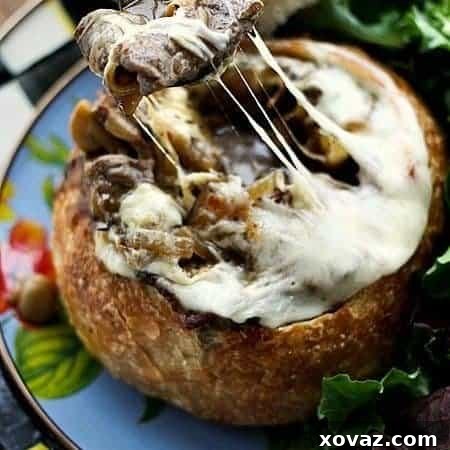
Philly Cheesesteak Stew
Recipe by: Rebecca Lindamood
Summary: Rich beef gravy full of seasoned beef browned in butter, caramelized onions, and sautéed mushrooms in a crusty sourdough bread bowl, topped with cheese, broiled until bubbly, and served with a giant buttery crouton. Adapted gently from Barefeet in the Kitchen and The Cozy Apron.
Ingredients
- 2 pounds beef top round
- 3/4 teaspoon Kosher or Sea Salt (plus extra for seasoning)
- 3/4 teaspoon Cracked black pepper (plus extra for seasoning)
- 1 1/2 teaspoons granulated onion (divided)
- 5 tablespoons all-purpose flour (divided)
- 3 tablespoons canola, vegetable, or other neutral oil
- 4 tablespoons butter (divided)
- 2 onions (trimmed, halved, peeled, and cut into thin half moons)
- 8-10 ounces white or baby bella mushrooms (cremini, sliced – see Notes for ideal size)
- 1 teaspoon dried thyme
- 3 cloves garlic (peeled and minced or pressed)
- 4 cups beef stock
- 4 sourdough bread bowls (centers cut out to within 3/4-inch of the bottom and sides and reserved for croutons)
- 4 slices provolone cheese
Instructions
- Cut the beef round into very thin slices, approximately 1/2 an inch by 2 inches. Spread them on a cutting board, then sprinkle with the salt, cracked black pepper, 3/4 teaspoon of the granulated onion, and 2 tablespoons of the all-purpose flour. Toss thoroughly with your hands to ensure the beef is evenly coated.
- In a large, heavy-bottomed soup pot, warm 1 1/2 tablespoons of the canola oil over medium to medium-high heat. Add 1 tablespoon of butter and swirl to melt. Immediately scatter half of the seasoned beef over the hot fat, moving it just enough to ensure pieces are in contact with the pan bottom. Do not stir at this point. Allow it to cook undisturbed for 2 minutes. Use a sturdy spoon to stir and flip the pieces as best as possible, cooking for 1 additional minute. Transfer the browned beef to a heat-safe bowl using a slotted spoon. Add the remaining oil and another tablespoon of butter, then repeat the browning process with the rest of the beef. Once cooked, transfer to the bowl with the first batch and lightly tent with foil. Return the pot to the heat.
- There should be a good amount of fat remaining in the pan. If not, add another teaspoon of butter or oil. Add the sliced onions along with a pinch of salt and cracked black pepper. Reduce the heat to medium-low and cook the onions, stirring frequently, until they become soft and beautifully golden brown, which typically takes about 5 minutes. Be careful not to crisp or burn the onions; lower the heat further if they are browning too quickly.
- Stir in the sliced mushrooms with one more pinch of salt and continue to cook for 6 minutes. Add the dried thyme and minced garlic, stirring well until the garlic becomes fragrant. Sprinkle the remaining flour over the onion and mushroom mixture and stir thoroughly until it forms a thick paste. Raise the heat to medium and cook the mixture for 1 minute, stirring constantly. Pour in the beef broth all at once, stirring continuously until the mixture is smooth and combined. Increase the heat to medium-high and bring the stew to a boil.
- Allow the stew to boil for 2 minutes before returning the cooked beef and any accumulated juices to the pot, along with the remaining granulated onion. Reduce the heat to LOW and simmer gently until the stew has thickened to your desired consistency and the beef is tender. Taste the stew and adjust the seasonings, particularly salt, if needed.
- Preheat your broiler to HIGH. Arrange the hollowed-out sourdough bread bowls on a rimmed baking sheet. Butter the cut sides of the reserved bread caps (from hollowing the bowls) and place them next to the bowls on the baking sheet. Ladle the hot stew into each bread bowl. Place one slice of provolone cheese on top of each filled bowl. Broil until the cheese is bubbly and lightly golden brown in spots. Using a large, flat spatula, carefully transfer the stew-filled bread bowls to individual serving plates. Serve each with its toasted bread cap.
Notes
- The size of the mushrooms will determine how you should slice them. If they are quite small, quartering them will be perfect. If they are medium to large in size, they should be halved from cap through stem, turned on the cut side, and thinly sliced. The end goal is bite-sized mushrooms throughout the stew.
- If your soup pot has a smaller footprint, you may find it necessary to divide the beef into smaller batches for browning to prevent overcrowding the pan. This is fine! You can still add the fat to the pan as specified in the recipe, and in all likelihood, you will not have to add fat before browning the last batch.
Nutritional information provided is an estimate and should be calculated with the actual ingredients used in your recipe using your preferred nutrition calculator for accuracy.
Made this delicious recipe?
We’d love to see your creations! Share your photos on Instagram and tag @foodiewithfam and use the hashtag #foodiewithfamily so we can check it out!
Pin Recipe
Share on Facebook